Part 19 min read
How to Evaluate CRM Vendors: Why Requirements Must Come Before the Demo
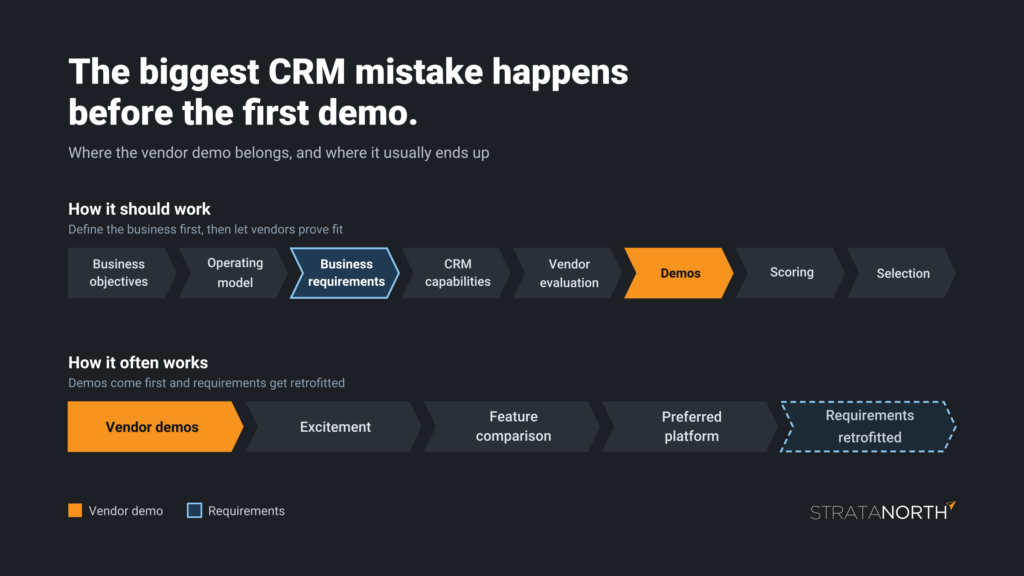
The most common selection mistake is starting with the CRM.

Nine field-tested lessons on choosing a CRM you won’t regret, from 26 years and more than 280 implementations.
Not ready to talk? Take the 3-minute CRM Readiness Assessment

Mario F. Calisto
Co-Founder and Consulting Partner, StrataNorth
Every post in this series comes back to one idea. Most CRM projects don’t struggle because the software can’t do enough. They struggle because the business never decided how it wanted to operate, and the technology was chosen first.
Start with your requirements. Then let each vendor prove it belongs.
1
Decide how your business needs to operate. That’s what the CRM has to support.
Part 19 min read
The most common selection mistake is starting with the CRM.
Part 210 min read
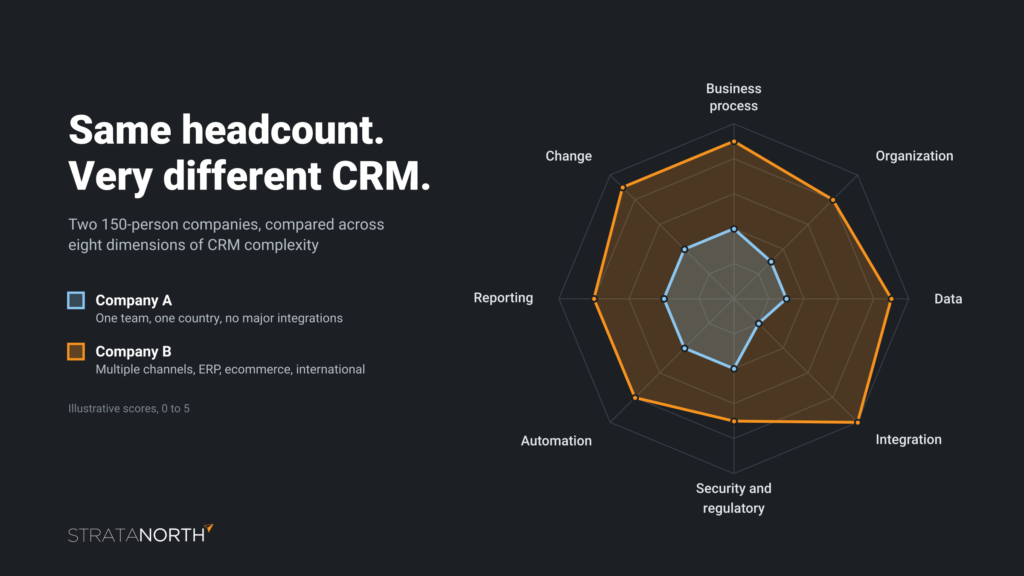
Company size is a poor predictor of CRM cost and timeline. Complexity is a better one.
Part 39 min read
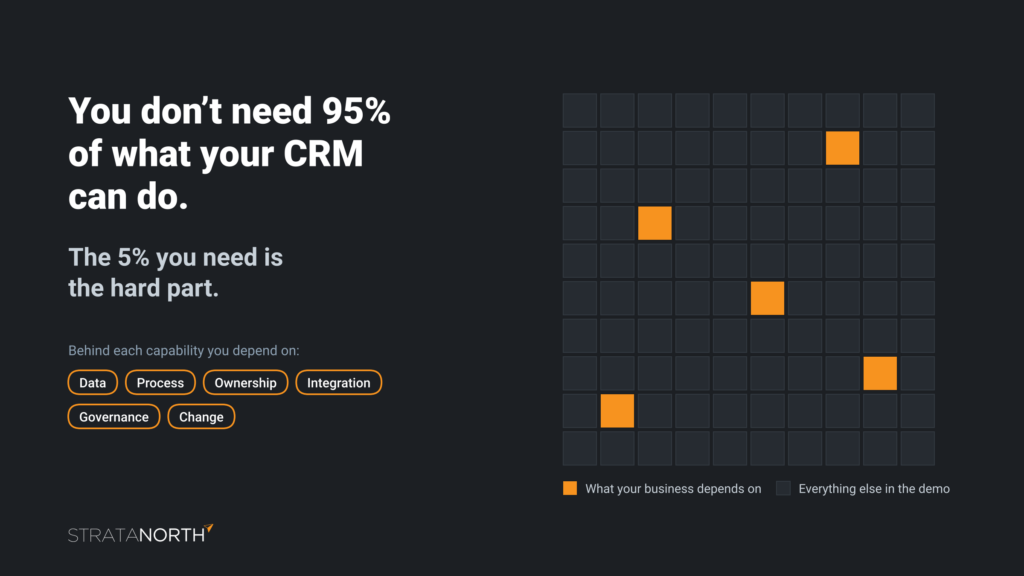
Your CRM can do it. The question is whether your organization can.
2
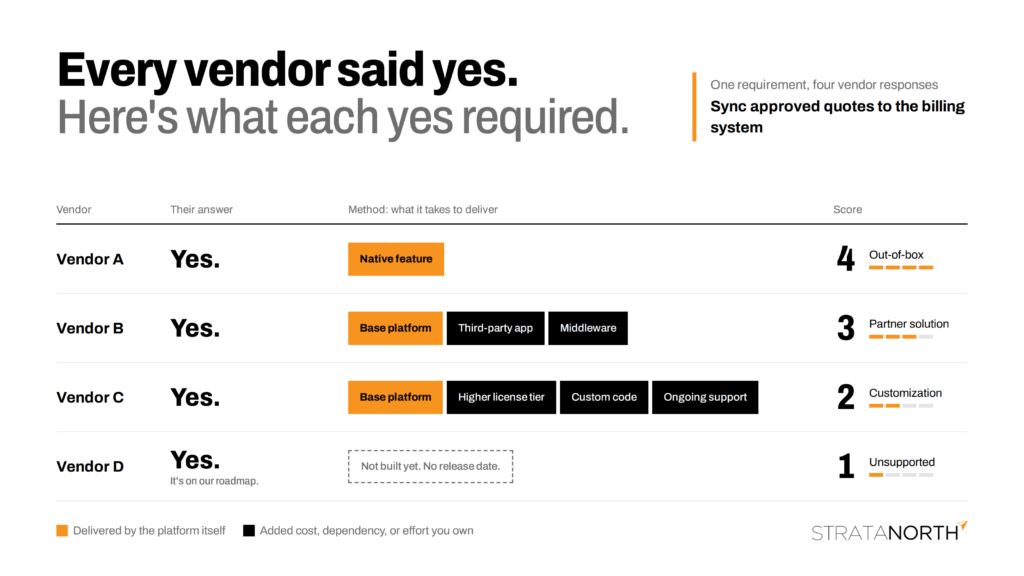
Test what each vendor’s yes really means, then weigh fit over score.
Part 44 min read
Four vendors can give the same answer and mean four very different things.
Part 56 min read
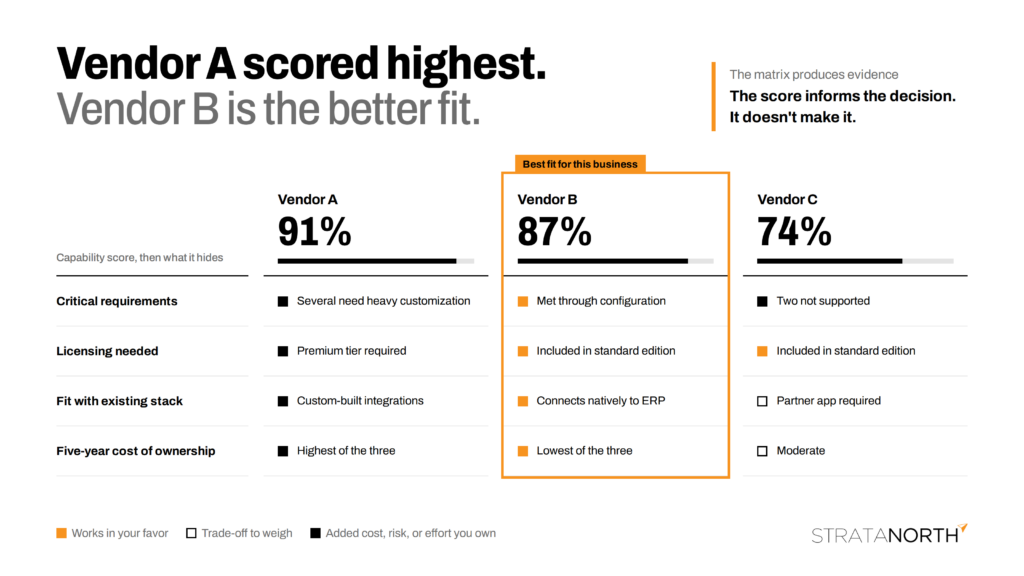
The score informs the decision. It doesn’t make it.
3
Selecting the CRM is half the decision. Delivery is the other half.
Part 67 min read
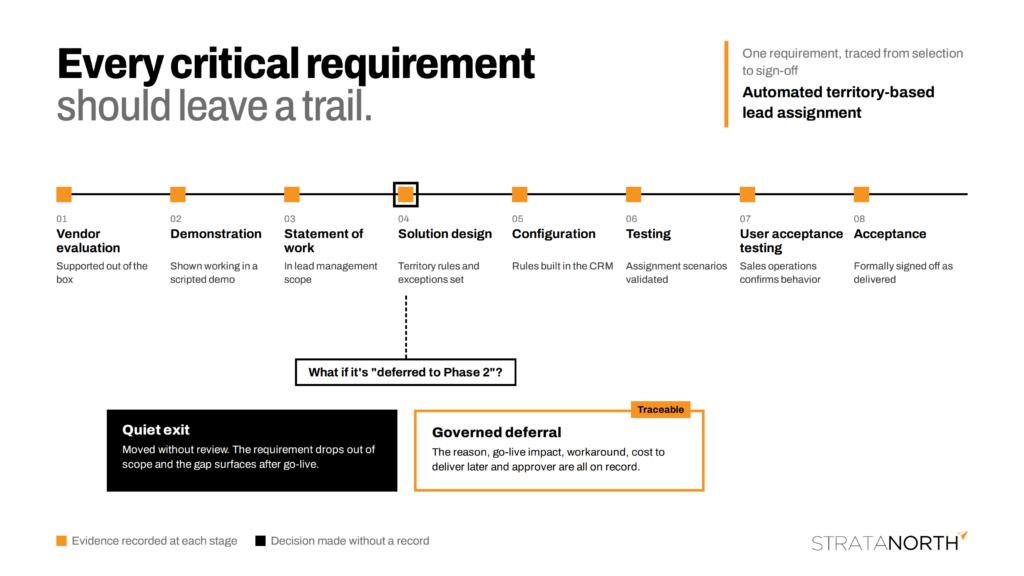
Every critical requirement should leave a trail from selection to sign-off, so nothing quietly disappears into “Phase 2.”
4
AI amplifies whatever your CRM is built on. Get the foundations right first.
Part 712 min read
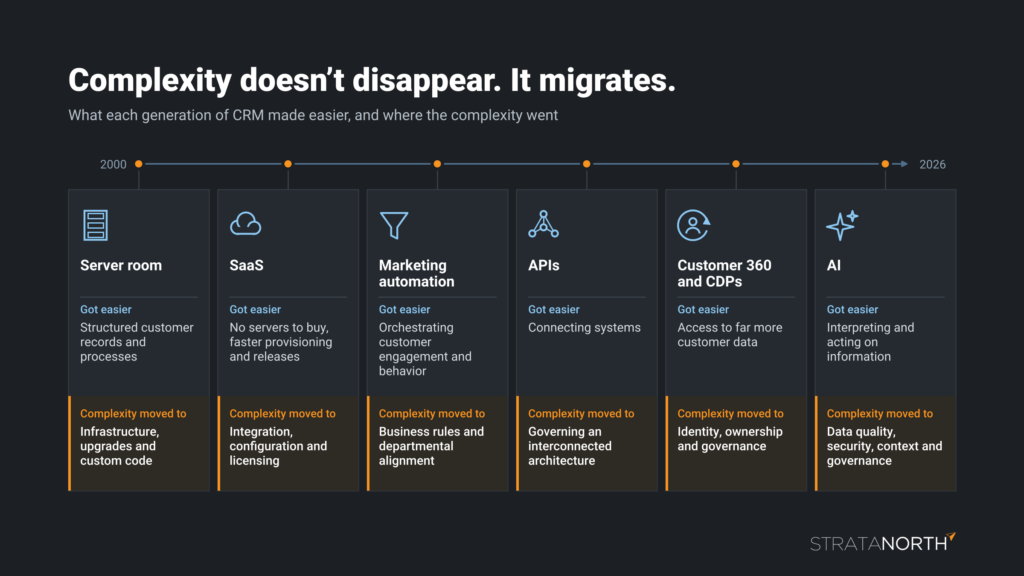
Every generation promised simplicity. The complexity just moved somewhere else.
Part 89 min read
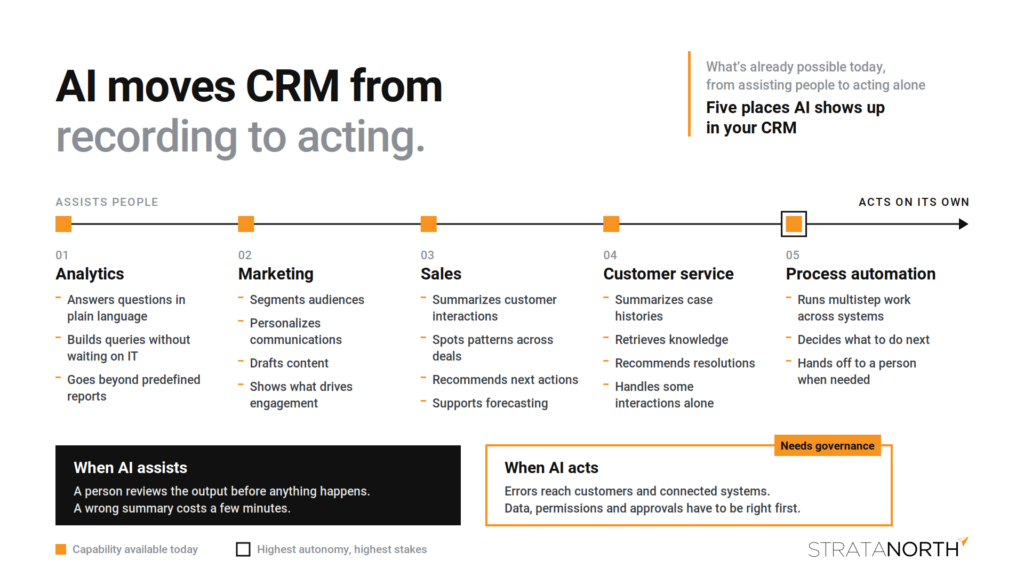
AI raises the stakes on everything CRM programs have always neglected.
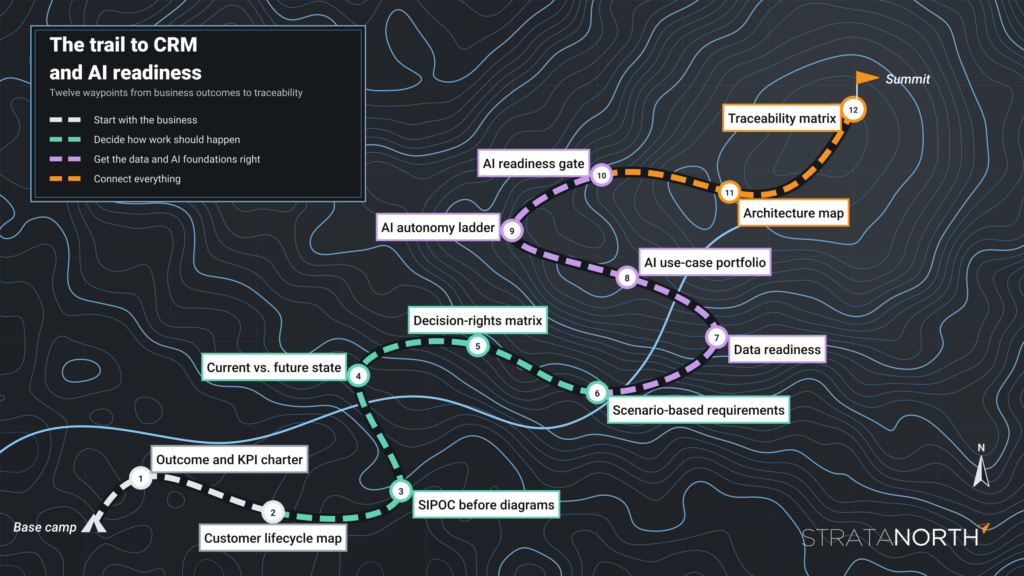
Part 99 min read
Twelve steps from business outcomes to a traceable business capability.
In healthcare, life sciences and financial services, security and governance carry extra weight in every CRM evaluation. Part 5 shows where they fit alongside capability, cost and adoption.
Will the vendor sign a HIPAA business associate agreement? Who can see protected health information, and how does it move between the CRM and your clinical and service systems?
Healthcare at StrataNorthDoes the platform support validated systems for regulated electronic records, with the audit trails and change control your quality team expects?
Life sciences at StrataNorthCan it meet your recordkeeping and audit obligations, and control who sees which clients, accounts and communications?
Finance at StrataNorthMario F. Calisto, on what 280 implementations have in common
People adapt with spreadsheets, emails and memory. The CRM project is the moment someone has to decide what the real process is.
Sometimes the platform’s standard process is the right call. Sometimes it isn’t. The choice should always be deliberate. More in Part 3
“You could build that, but you probably shouldn’t.” Sometimes it’s the most valuable thing an implementation partner can say.
Choosing the right partner, in Part 6Mario F. Calisto has worked in CRM since 2000. He has led more than 50 CRM advisory engagements and more than 280 implementations, across every generation of the technology, from on-premises servers to SaaS, marketing automation and now AI.
A large share of his advisory work has involved projects that went off the rails. He co-founded StrataNorth to help organizations avoid getting there. StrataNorth doesn’t resell CRM software, so his advice starts with how your business needs to operate.
Technologies Mario knows first-hand





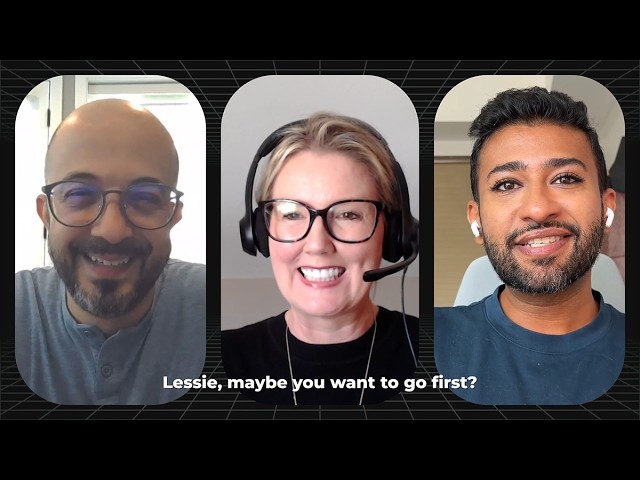
Mario’s podcast. Episode 1: Building the Foundation, CRM Strategy Before Software
Free tools built on the same approach as the series.
Twelve questions, about three minutes, and a score for where your foundations stand.
Make every vendor demonstrate your requirements, then compare them on equal terms.
Find your stage, the mistake to avoid there, and a note to send your buying group.
The short guide as a PDF, for anyone who prefers to read offline.
Tell us where you are and what you’re trying to decide, and we’ll be in touch.
Prefer to pick a time now?
Book a CRM exploration call