
The three questions clients ask most about CRM, and why every honest answer starts with “it depends.”
Part 2 of 9 in our CRM Selection series.
In How to Evaluate CRM Vendors, I argued that the most common selection mistake is starting with the CRM. This post looks at what starting with the business means for the person sitting across the table from me, trying to decide what to buy, how long it will take and what it will cost.
Twenty years ago, it was much easier to think of CRM as a sales application: accounts, contacts, leads, opportunities, activities and forecasts. Those capabilities still matter, but the boundary around CRM has largely disappeared. CRM now sits at the intersection of customers, processes, people, data, workflow, revenue, service and technology.
That changes the nature of the decision. You’re no longer simply choosing software for your salespeople. In many organizations, you’re designing a significant part of the operating model through which the company acquires, develops, serves and retains customers. That’s considerably more complicated, and it explains the three questions I’ve heard most often over 26 years in CRM.
Key Takeaways
-
“Which CRM is best?” is the wrong question. The better one is which CRM best fits the operating model you’re trying to create.
-
Company size is a poor predictor of CRM cost and timeline. Process, data, integration, security and change complexity are much better ones.
-
The fastest way to shorten a CRM implementation is to make more decisions before it starts.
CRM Isn’t Just a Sales System Anymore
Look at what each part of the business now expects from CRM:
|
Function |
What it needs |
|---|---|
|
Sales |
Marketing history, plus visibility into open service issues before calling an important customer |
|
Marketing |
Sales outcomes |
|
Customer service |
Account, product, transaction, entitlement and interaction history |
|
Ecommerce |
Customer identity, preferences and purchase history |
|
Finance |
Commercial commitments, contracts, credit status or customer profitability |
|
Executives |
Consolidated customer, pipeline, revenue and retention analytics |
|
AI |
Increasingly, all of it |
ERP runs the business. CRM increasingly runs the customer relationship.
That’s an oversimplification, but a useful one. For many organizations, ERP remains the operational and financial system of record for products, inventory, orders, fulfillment, invoicing, purchasing and accounting. CRM often becomes the primary system for customer-facing relationships and commercial activity. The two worlds constantly intersect, and so do the others around them:
|
Flow |
What it involves |
|---|---|
|
Selling |
Account → Contact → Lead → Opportunity → Quote → Activities → Forecast |
|
Fulfilling what was sold |
Product → Pricing → Inventory → Credit → Order → Fulfillment → Shipment → Invoice → Payment |
|
After the sale |
Service → Warranty → Returns → Renewals → Upsell → Cross-sell → Retention |
|
Marketing |
Campaign → Engagement → Lead → Qualification → Attribution → Pipeline → Revenue |
|
Ecommerce |
Digital identity → Browsing → Cart → Order → Payment → Fulfillment → Returns → Customer profile |
|
AI |
Customer history → Transactions → Communications → Service interactions → Behavioral signals → Recommendations → Predictions → Generated content → Automated actions |
Suddenly, what started as a “CRM project” isn’t confined to CRM at all. It may touch ERP, marketing automation, ecommerce, customer service, identity management, integration platforms, data warehouses, analytics, telephony, email, collaboration platforms, master data, product information, consent management and AI.
This isn’t theoretical. McKinsey’s 2026 Global B2B Pulse Survey, based on nearly 4,000 decision-makers in 13 countries, found that buyers now use an average of ten channels across the purchasing journey. It also found that 71% of B2B companies offer ecommerce, and among those, roughly a third of revenue flows through digital channels. When the customer journey is that interconnected, the systems supporting it have to be interconnected too.
The CRM software usually isn’t the complicated part. The business the CRM represents is. That distinction explains a lot about the questions clients ask me.
Question 1: “What CRM Platform Do You Recommend?”
This is probably the CRM question I’ve been asked more than any other, and I understand why. Someone learns I’ve worked with CRM platforms for more than two decades and naturally thinks, “Great. Save me six months of research. Which one should we buy?”
My answer is usually: it depends. Some days I love them all. Other days I hate them all. I say that somewhat tongue in cheek, but there’s a real point behind it. I certainly prefer particular platforms for particular situations, but the major CRM platforms today are extraordinarily capable. The question usually isn’t which CRM has the most features. A better question is which CRM best fits the operating model we’re trying to create? Those are very different questions.
A feature comparison only tells part of the story
Suppose three CRM platforms can all manage opportunities. Wonderful. Now ask what opportunity management actually means inside your company:
-
How are opportunities created, who owns them, can ownership change and can multiple people receive credit?
-
What determines the stage, and what criteria must be met before an opportunity can advance?
-
Who approves discounts, where does pricing originate, and does the CRM or the ERP calculate the quote?
-
What happens when inventory isn’t available, and does the salesperson need visibility into available-to-promise inventory?
-
How are territories determined, commissions calculated and channel partners represented?
-
How are subsidiaries and parent companies structured, and what happens when an opportunity spans multiple business units?
-
How are recurring revenue, renewals and revenue recognition handled?
-
Which system owns the customer record?
Those questions have very little to do with whether a vendor can put a checkmark next to “Opportunity Management” on an RFP.
Most platforms get you most of the way. The remaining distance can be expensive.
A platform might satisfy 90% of your requirements. That sounds excellent, until the missing 10% turns out to contain your most strategically important or operationally complex ones. Closing that gap might require custom development, third-party applications, middleware, additional licensing, new data infrastructure, more administrative resources, manual workarounds, or changes to your business processes, security model or organizational structure.
That’s why I don’t evaluate CRM platforms on feature coverage alone. The real evaluation covers functional, process, architectural, integration, data, security, organizational and administrative fit, along with implementation complexity, scalability and total cost of ownership. Increasingly, it also covers AI readiness. That multidimensional view is what the CRM Vendor Capability Matrix is built around, and we cover how to weigh scores against fit in The Highest-Scoring CRM Isn’t Necessarily the Right CRM.
AI is making CRM architecture more important
There’s an understandable assumption that AI will simplify many of these problems. Eventually, it may. Today it more often exposes them. An AI assistant asked to summarize an account relationship needs the account’s history, and that history may live in CRM, ERP, email, Teams, customer service, marketing automation, ecommerce, a data warehouse, or all of the above.
Salesforce’s 2026 State of Sales research, a survey of more than 4,000 sales professionals, found that 51% of sales leaders using AI say disconnected systems are slowing their AI initiatives, and 74% of sales professionals are prioritizing data cleansing. High performers were far more likely than underperformers to prioritize data hygiene, 79% versus 54%.
AI doesn’t eliminate the need for CRM architecture, data governance and process discipline. It increases their importance. We go deeper on this in AI in CRM: Why Data Quality and Business Readiness Still Matter.
Question 2: “How Long Will It Take and What Will It Cost for a Company Like Mine?”
Again: it depends. I know. At this point I’m really starting to sound like a consultant. But after hundreds of implementations, I’d be doing a client a disservice by pretending there’s a reliable answer based on employee count, revenue or number of CRM users. I’ve seen large organizations with surprisingly straightforward CRM requirements and small companies with remarkably complex ones.
Company size is a poor proxy for CRM complexity
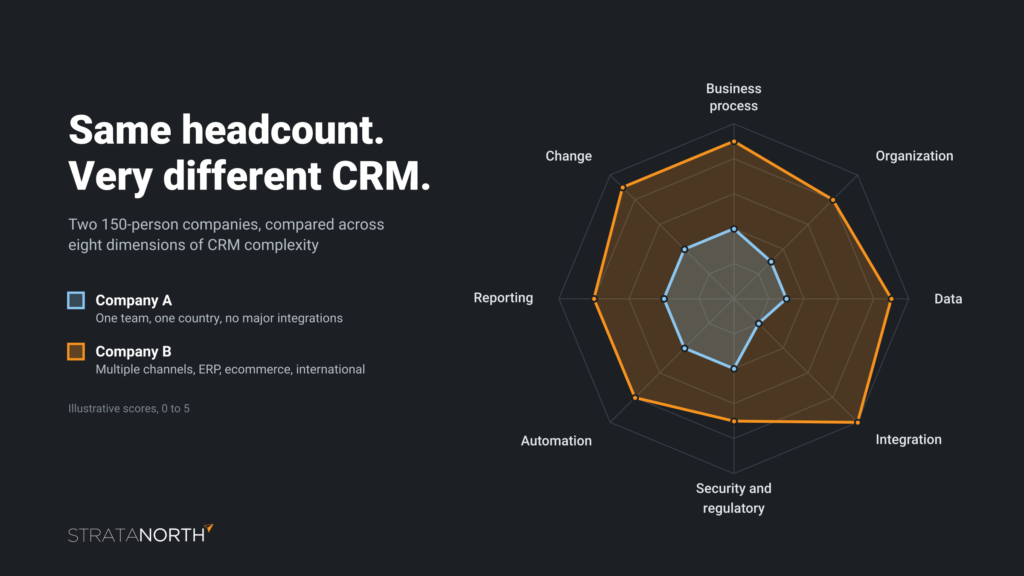
Consider two companies with 150 employees each:
|
|
Company A |
Company B |
|---|---|---|
|
Sales model |
One sales team, one straightforward process |
Multiple channels, distributors and direct customers |
|
Geography |
One country, one currency |
International operations |
|
Pricing and products |
Simple |
Complex and contractual pricing across multiple product families |
|
Systems |
No major integrations |
ERP, ecommerce, marketing automation and customer service |
|
Data |
Limited history |
Years of historical customer data |
Same headcount. Not remotely the same CRM implementation. That’s why I assess CRM complexity across several dimensions:
|
Dimension |
The questions behind it |
|---|---|
|
Business process |
How many sales motions exist, how standardized are they and how many exceptions are there? |
|
Organizational |
How many departments, regions, business units, brands and channels participate? |
|
Data |
How much data exists, where is it, how clean is it and what’s the authoritative customer record? |
|
Integration |
Which systems must CRM exchange information with: ERP, ecommerce, marketing, service, telephony, data platforms, partner portals? |
|
Security and regulatory |
Who can see which customers, opportunities, contracts, cases and communications, and are there geographic, regulatory or contractual restrictions? |
|
Automation |
What workflows, approvals, routing rules, notifications and automated decisions are required? |
|
Reporting |
What does leadership need to understand about pipeline, conversion, retention, service, revenue and profitability? |
|
Change |
How differently will people need to work after implementation? |
That last dimension is routinely underestimated.
CRM implementation isn’t just software configuration
Organizations sometimes assume implementation looks like this:
Buy CRM → Configure CRM → Migrate data → Train users → Go live
In practice, a transformation looks more like this, with several workstreams running at the same time:
Strategy → Requirements → Process design → Data model → Architecture → Integration design → Security design → Configuration → Development → Migration → Testing → Training → Deployment → Adoption → Optimization
Each workstream can uncover decisions that affect another. During data migration, for example, you discover that one customer exists six times across three systems. Now it’s a master-data question. Which record survives, and who decides? What counts as a duplicate, and should subsidiaries be separate accounts? What happens to historical activities, open opportunities, marketing consent, service history and ERP customer IDs? What happens when two ERP customers correspond to one commercial account?
A task originally described as “migrate the customer data” has become an enterprise data-governance discussion. That’s CRM implementation.
Question 3: “What Can We Do to Speed This Up?”
This may be my favorite of the three, because the answer is counterintuitive: one of the best ways to make a CRM implementation faster is to do more work before it begins. Time spent creating clarity beforehand can eliminate much more time spent resolving ambiguity during the project.
The fastest project isn’t necessarily the one with the shortest plan
Picture an implementation team in a requirements workshop with sales, marketing and operations. The consultant asks, “What counts as a qualified lead?” Marketing gives one answer and sales gives another. Operations has never been part of the discussion, and leadership assumed it had already been decided. Now six people, including expensive implementation resources, are debating a business-process question that could have been settled before the systems integrator (SI) arrived.
Multiply that across lead qualification, account ownership, opportunity stages, territories, pricing, approvals, forecasting, customer hierarchy, marketing attribution, service escalation, data retention, duplicate management, security roles, reporting and integrations. Suddenly “discovery” becomes months of organizational decision-making.
Preparation changes the economics of implementation
A prepared organization enters implementation knowing what business outcomes it expects, which processes need to change, which requirements are critical and which are optional, which systems own which data, what integrations and historical data are in scope, who owns decisions and data, who will administer the platform and how success will be measured. An unprepared organization expects the implementation partner to discover those answers during the project. That difference can dramatically change cost, schedule and risk, and it’s the work our 12-step readiness framework is designed to front-load.
Why CRM schedules expand
When CRM implementations run long, the cause is rarely that configuring a field or building a workflow took too long. The delays happen around decisions and dependencies:
|
Cause |
What it looks like |
|---|---|
|
Undefined requirements |
The organization knows what it dislikes about today but hasn’t defined the future state. |
|
Unresolved process disagreements |
Sales, marketing, service and leadership expect the customer lifecycle to work differently. |
|
Underestimated data problems |
Duplicates, missing values, inconsistent identifiers and incompatible history surface during migration. |
|
Integration surprises |
A seemingly simple ERP or ecommerce integration contains dozens of undocumented business rules. |
|
Excessive customization |
The organization recreates years of legacy behavior instead of adopting standard platform patterns. |
|
Scope expansion |
Once users see the platform, new requirements emerge. |
|
Decision latency |
Questions sit unanswered for weeks because nobody knows who has the authority to decide. |
|
Resource constraints |
Subject-matter experts still have full-time jobs. |
|
Testing compression |
Earlier delays eat the time set aside for integration testing, user acceptance testing and fixes. |
|
Change-management underinvestment |
Technical readiness arrives before organizational readiness. |
None of those problems are solved by asking developers to configure the CRM faster. Once the project is under way, holding your partner accountable for these risks matters too, which we cover in You Chose the CRM. Is Your SI Delivering What You Bought?
So how long should a CRM implementation take?
There’s no responsible single benchmark without understanding scope, but the ranges look roughly like this:
|
Scope |
Typical timeline |
|---|---|
|
Focused implementation for a smaller organization using mostly standard functionality, limited integrations and fairly clean data |
Weeks to a few months |
|
Broader implementation spanning multiple departments, integrations, significant migration, process redesign, custom development and organizational change |
Many months |
|
Enterprise customer transformation across sales, marketing, service, ecommerce, ERP, data platforms, analytics and multiple business units |
A year or more, sometimes multiple years |
The useful question isn’t “How long does CRM take?” It’s “What are we actually transforming?” That question produces a much better estimate.
The Hidden Variable Is Operational Maturity
Two companies can buy the same CRM platform, hire equally capable implementation partners and pursue similar functionality, yet get dramatically different outcomes. Technology isn’t the only variable.
One organization can answer who owns the customer, what counts as a qualified lead, when an opportunity advances, which system owns pricing, who owns customer data, who approves exceptions, what’s required before an opportunity closes, what an accurate forecast means, how renewals work and which KPIs will show whether the implementation succeeded. The other can’t.
The second organization doesn’t simply have a CRM implementation problem. It has unresolved operating-model decisions that the implementation is exposing.
AI raises the stakes further. Lead prioritization, opportunity intelligence, account research, forecasting, next-best actions, personalized outreach, service automation, churn prediction and cross-sell recommendations all depend on something underneath:
|
AI capability |
What it depends on |
|---|---|
|
Opportunity recommendations |
Reliable opportunity data |
|
Personalization |
Customer identity and behavioral data |
|
Churn prediction |
Transaction and engagement history |
|
Automated service |
Accurate product and entitlement information |
|
Next-best actions |
Business rules and context |
|
Forecasting |
Disciplined pipeline management |
The more intelligent CRM becomes, the more important the fundamentals become.
CRM Has Become an Operating Model Decision
A CRM decision used to be easy to frame as “What system should our salespeople use?” Today the better question is “How do we want to acquire, understand, sell to, serve and retain customers, and what combination of processes, people, data and technology will let us do that?”
That’s a fundamentally different conversation. It explains why selecting a CRM is hard, why implementation estimates vary so dramatically, why simple-sounding integrations get complicated, why data migration turns into data governance, why CRM projects uncover organizational disagreements and why adoption can’t be solved with training alone. It also explains why so many CRM answers begin with those two frustrating words: it depends.
After more than 26 years in this space, I don’t see “it depends” as avoiding the answer. It means we haven’t made enough assumptions yet to pretend we know it. The job of good CRM advisory is to work out exactly what it depends on: the business model, customer lifecycle, processes, people, data, architecture, integrations, governance, economics and desired outcomes, before a platform, implementation partner or impressive demo dictates the solution.
Find Out What Your CRM Decision Depends On
StrataNorth helps organizations answer these three questions with evidence instead of guesswork. We define the operating model first, assess complexity across every dimension above, and evaluate platforms and implementation partners against it. We don’t resell CRM software, so our recommendations aren’t tied to any vendor.
Start with the free CRM Readiness Assessment to see how prepared you are, then use the CRM Vendor Capability Matrix to compare platforms on fit, not just features. When you want an independent perspective, book a CRM exploration call or explore our CRM advisory services.
A successful CRM implementation is measured by whether your organization operates better because of it.
Listen: The CRM Advantage, Episode 1, Building the Foundation: CRM Strategy Before Software
Previous in this series: Part 1: How to Evaluate CRM Vendors: Why Requirements Must Come Before the Demo
Next in this series: Part 3: CRM Features vs. Business Capabilities: Why the 5% You Need Is the Hard Part