
Why CRM advisory shouldn’t end when the software contract is signed.
Part 3 of 9 in our CRM selection series.
Selecting the CRM and selecting the company that will implement it are two different decisions.
Organizations often spend months evaluating CRM platforms: gathering requirements, attending demonstrations, comparing capabilities, negotiating licensing and building the business case. Then the contract gets signed, and much of the responsibility for turning that decision into reality shifts to a system integrator (SI), the firm hired to implement the platform.
That is where a different set of risks begins. A company can select the right CRM and still end up with the wrong implementation. The platform may be fully capable of supporting the business requirements, but if the implementation is poorly architected, over-customized, understaffed, badly integrated or disconnected from the original business objectives, the technology selection won’t save the project.
Choosing the right CRM answers one question: “What platform should we buy?” Choosing and managing the right SI answers another: “How do we make sure we get what we bought?”
In Every CRM Vendor Says Yes and The Highest-Scoring CRM Isn’t Necessarily the Right CRM, we covered how to evaluate CRM platforms and turn the results into a decision. This post covers what comes next: making sure the implementation delivers what you selected.
Key Takeaways
-
The SI you choose shapes the outcome as much as the CRM platform does, so SI selection deserves its own evaluation.
-
The statement of work (SOW) is where sales promises become contractual commitments. Reconcile it against your requirements before signing.
-
Requirements traceability and independent governance keep deferrals, workarounds and change requests from quietly eroding the business case.
Your CRM Doesn’t Implement Itself
CRM vendors typically have an ecosystem of implementation partners, from global consulting firms to specialized boutique SIs. They are not interchangeable. Two SIs can propose implementations of the same CRM platform and produce very different architectures, timelines, staffing models, costs and outcomes.
That is why SI selection deserves its own evaluation process. Look beyond the presentation deck and evaluate each SI across these areas:
|
Area |
What to evaluate |
|---|---|
|
Experience |
Relevant industry and business process experience |
|
Solution design |
Proposed solution architecture, integration architecture and strategy, and their configuration versus customization philosophy |
|
Data |
Data migration methodology, and reporting and analytics approach |
|
Security and compliance |
Security and access-control design, and experience in your regulatory environment |
|
Delivery team |
Staffing model and resource seniority, named resources versus proposed resource profiles, and the onshore, nearshore and offshore delivery mix |
|
Methodology |
Implementation methodology, and testing and quality assurance approach |
|
Adoption |
Change management and user adoption |
|
Governance |
Project governance and escalation procedures, and stated assumptions, dependencies and exclusions |
|
Handover and support |
Knowledge transfer and documentation, and post-go-live support and stabilization |
|
Cost |
Total implementation cost and ongoing support model |
The question isn’t whether an SI knows Salesforce, Microsoft Dynamics 365, HubSpot or another CRM platform. It is whether that SI has shown it understands your business, your requirements, your architecture and the outcomes you expect from the investment.
The SOW Is Where Promises Become Commitments
One of the most important transitions in any CRM program happens between vendor selection and the implementation statement of work. During the sales process, conversations focus on capabilities. During contracting, those capabilities need to become commitments, and this is where organizations should be particularly careful. Common gaps include:
-
A requirement that seemed straightforward in a demonstration now carries an assumption.
-
An integration is described differently than it was during selection.
-
Data migration covers fewer objects or less history than expected.
-
Reporting is limited to standard reports.
-
A capability the software vendor demonstrated requires customization that isn’t in the implementation estimate.
Individually, these seem like small details. Collectively, they can materially change the implementation. Treat the SOW as more than a commercial document: it is one of the first major controls for protecting the original business case. Before signing, reconcile the proposed SOW against the requirements, vendor responses, demonstrations and assumptions that led to the platform decision.
Who Represents the Customer?
This is one of the most important questions in a CRM transformation. Every participant has a legitimate role and perspective:
-
The software vendor represents its platform.
-
The SI is responsible for delivering its implementation.
-
Sales, marketing, IT and finance each represent their own function.
But who is responsible for making sure the original business case, requirements and intended outcomes survive the implementation? That responsibility often becomes fragmented. Without clear ownership, decisions made during implementation can gradually move the project away from the reasons the organization invested in the CRM. For example:
-
A requirement gets deferred.
-
An integration gets simplified.
-
A workflow becomes manual.
-
A report becomes “future phase.”
-
A customization gets introduced because it solves an immediate problem.
-
A business process gets designed around the technology rather than the business.
None of these decisions is a project failure on its own, and some may be entirely appropriate. The problem comes when they happen without anyone understanding their cumulative effect on the business case.
Your Capability Matrix Can Become a Traceability Tool
This is where the work done during CRM selection becomes valuable again. The CRM Vendor Capability Matrix doesn’t have to be retired once a vendor is selected. The requirements used to evaluate the platforms can become the foundation for requirements traceability throughout the implementation: a continuous chain of evidence showing that each critical requirement was delivered and accepted.
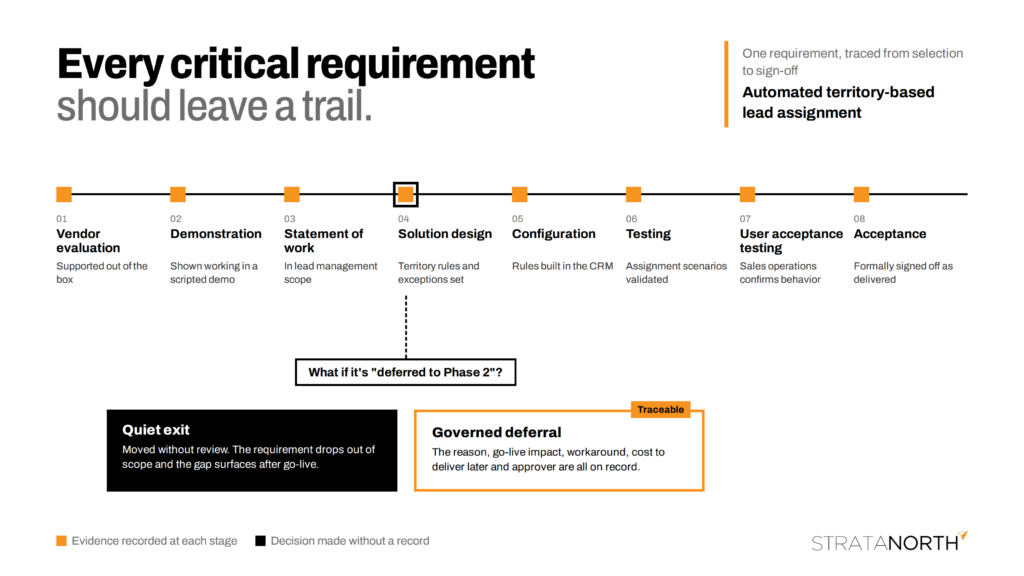
One CRM requirement traced through eight stages from vendor evaluation to acceptance, with a Phase 2 deferral either recorded and approved or lost without review.
Here is how one requirement, automated territory-based lead assignment for sales representatives, moves through that chain:
|
Stage |
Evidence |
|---|---|
|
Vendor evaluation |
Supported out of the box |
|
Demonstration |
Capability demonstrated successfully |
|
SOW |
Included within lead management configuration |
|
Solution design |
Territory rules and exception handling documented |
|
Configuration |
Rules configured in the CRM |
|
Testing |
Assignment scenarios validated |
|
User acceptance testing (UAT) |
Sales operations confirms expected behavior |
|
Acceptance |
Requirement formally completed |
Now imagine the same requirement reaches solution design and becomes “Deferred to Phase 2.” That might be the right call. Priorities change, budgets change and new information emerges during implementation. But a critical requirement shouldn’t quietly disappear because someone decided it was easier to move it. The decision should be visible, understood and approved. That is the purpose of traceability.
Beware of “Phase 2”
“Phase 2” can be a legitimate part of an implementation roadmap. It can also become the place where difficult requirements go to disappear. Every significant deferral should answer a few basic questions:
-
Why is this being deferred?
-
What business capability will be unavailable at go-live?
-
Is there a temporary workaround?
-
Does the deferral change the business case or expected benefits?
-
What is the cost and effort to implement it later?
-
Who approved the decision?
That turns “Phase 2” from a convenient parking lot into an explicit governance decision.
Change Requests Deserve the Same Scrutiny
The same principle applies to change requests. CRM programs evolve: new requirements emerge, data problems are discovered, integrations prove more complicated than expected, and business teams learn more about what they need once they see the system taking shape. Change is normal. Uncontrolled change is expensive.
Before approving a significant change request, understand which of these it represents:
-
A genuinely new requirement
-
A previously documented requirement that was missed
-
An incorrect implementation assumption
-
A scope clarification
-
A change to the original business decision
Those distinctions matter. Without requirements traceability, organizations can end up paying change-order fees for capabilities they believed were already included.
Implementation Governance Is More Than Project Management
Most CRM implementations already have project managers. Independent implementation oversight serves a different purpose. Project management asks whether tasks are being completed, milestones are on schedule, and risks and issues are being tracked. Implementation governance also asks:
Are we still building the solution the business intended to buy?
That means keeping requirements, architecture, scope, cost, schedule, integrations, data, testing and business outcomes aligned. It also means bringing an independent perspective when difficult decisions come up between the business, the software vendor and the SI. The objective isn’t to second-guess the implementation partner. It is to create transparency and accountability around the decisions that determine whether the program succeeds.
The Most Expensive CRM Isn’t the One With the Highest License Cost
It’s the one you have to implement twice. CRM programs rarely fail because the software can’t store contacts, manage opportunities or send marketing communications. Problems more often come from where technology meets execution: unclear requirements, poor process design, unnecessary customization, underestimated integrations, weak data quality, inadequate testing, uncontrolled scope and insufficient adoption.
By the time those problems become obvious, organizations may have invested heavily in licensing, consulting, integrations, migration and internal resources. Independent oversight is less about adding another layer of project administration and more about protecting the investment already being made.
If your implementation is underway or about to start, book a CRM exploration call to talk through where independent oversight would help.
From CRM Selection to CRM Success
A CRM Capability Matrix can help answer “Which platform best aligns with our requirements?” Once the platform is selected, the next challenge begins: “How do we make sure the implementation delivers those requirements?” That takes continuity between the business case, requirements, vendor selection, SI selection, SOW, solution design, implementation, testing and acceptance.
Smaller or more straightforward implementations can often be managed internally. For larger programs with multiple integrations, complex data environments, cross-functional requirements or significant investment, independent advisory and implementation oversight adds a layer of governance between the business, the CRM vendor and the SI.
At StrataNorth, we don’t resell CRM software, and we don’t need to win the implementation work. Our role is different: we represent the customer.
We help organizations evaluate CRM platforms and implementation partners, challenge assumptions, review SOWs and architecture, maintain requirements traceability, oversee implementation decisions and make sure what was promised during selection stays visible through delivery.
We’re giving you the methodology and tools to do much of this yourself. Download the CRM Vendor Capability Matrix to get started. When the complexity, investment or organizational risk makes independent guidance worthwhile, book a CRM exploration call and we’ll help protect the decision all the way through implementation.
Selecting the right CRM is only the beginning. The real measure of success is whether the business gets what it selected.
Previous in this series: The Highest-Scoring CRM Isn’t Necessarily the Right CRM