
How to evaluate CRM vendors without letting the sales process control the decision.
Part 1 of 9 in our CRM selection series.
Ask three CRM vendors whether their platforms can meet your requirements and you will probably hear the same answer three times: yes.
That is not necessarily because vendors are being misleading. Modern CRM platforms are extraordinarily flexible. Between native functionality, configuration, third-party applications, integrations, custom development and different licensing tiers, there are often several ways to make a requirement technically possible.
The problem is that “yes” tells you almost nothing about how the requirement will be delivered, and that distinction has major implications for cost, complexity, implementation effort and long-term ownership.
Key Takeaways
-
A vendor’s “yes” doesn’t tell you how a requirement will be delivered, and the how drives cost, complexity and long-term ownership.
-
Define your business requirements before bringing vendors in, so the evaluation isn’t shaped by their sales demos.
-
A CRM Vendor Capability Matrix scores each requirement by how it is delivered and records the method, so vendors can be compared on equal terms.
Requirements First. Vendors Second.
One of the most common mistakes we see in CRM evaluations is bringing vendors into the process too early. Once that happens, the evaluation quickly becomes vendor-led. Vendors naturally demonstrate what their platforms do best, their preferred use cases shape the conversation, and nearly every requirement gets some version of “yes.”
A better approach is to define your business requirements before asking vendors to respond to them. Start with questions like these:
-
What does the business need the CRM to do?
-
Which capabilities are essential, and which are desirable?
-
Where are your current processes failing?
-
What will different users, departments and customer-facing teams expect from the future platform?
Only once you understand those requirements should you begin evaluating which technology can satisfy them.
Turn “Can You Do This?” Into “Show Us How”
One of the tools we use to structure this process is a CRM Vendor Capability Matrix. It is a straightforward methodology, but it consistently changes the quality of a CRM evaluation.
Instead of asking a vendor “Can your CRM do this?”, the matrix asks:
“Show us exactly how your platform satisfies this requirement, what is required to make it work, and how we should score it.”
That is a very different conversation. The objective is no longer to find out whether something is technically possible. It is to understand how it is possible.
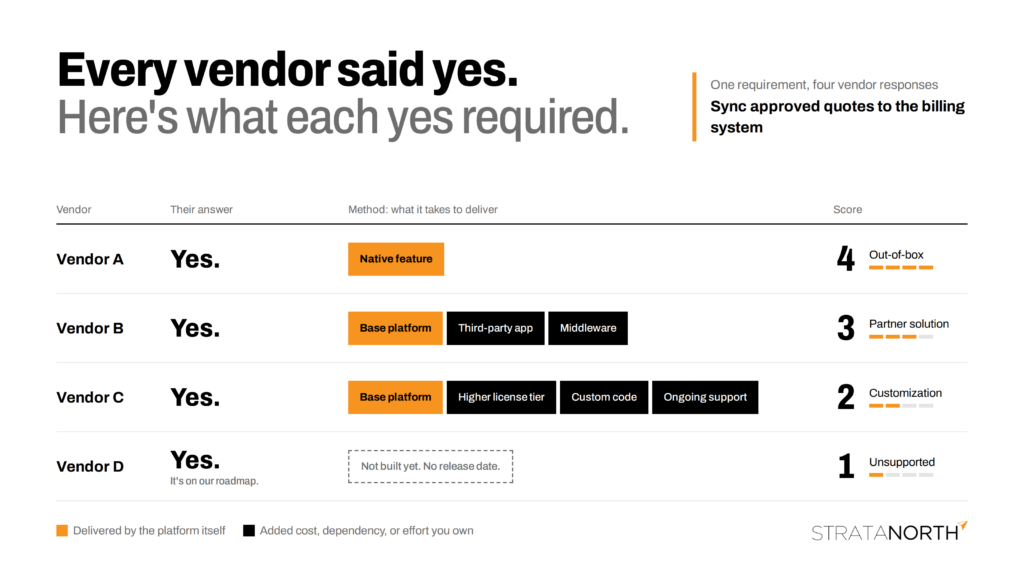
Not All “Yeses” Are Equal
Our CRM Vendor Capability Matrix uses a simple scoring methodology:
-
4: Out-of-box. The capability is available natively within the platform.
-
3: Partner solution. The capability requires a third-party or partner solution.
-
2: Customization. The capability requires custom development or significant customization.
-
1: Unsupported. The platform does not reasonably support the requirement.
The score gives a useful quantitative comparison between vendors, particularly when evaluating dozens or hundreds of requirements. But another part of the matrix is just as important: the Method column.
The Method column captures how the vendor intends to deliver the capability, because there can be a wide gap between “yes, we support that” and what it takes to make it work. A capability might be:
-
Available natively
-
Available through configuration
-
Dependent on custom development
-
Delivered through an independent software vendor (ISV) or other third-party application
-
Dependent on middleware or another integration
-
Available only with a higher licensing tier
-
Possible, but impractical for your particular use case
-
Planned for a future product release
And then there is the answer every technology buyer eventually hears: “Yes, but not yet. It’s on our roadmap.”
Technically, many of these answers begin with “yes.” Operationally and financially, they can mean very different things.
The Cost of “How” Often Appears Later
How a capability will be delivered is often glossed over during the sales process. It may not be until implementation, solution design or configuration begins that the organization discovers the true implications.
A seemingly simple requirement suddenly needs an additional product, middleware, custom code or a more expensive licensing tier. It may introduce another vendor that needs to be supported, or what appeared to be standard functionality may take far more implementation effort than anticipated.
Now the economics of the original decision begin to change:
-
Direct costs increase.
-
Implementation effort increases.
-
Testing requirements increase.
-
Technical dependencies increase.
-
Long-term support requirements increase.
The organization begins accumulating complexity it never realized it was buying. This does not necessarily mean the vendor pulled a fast one. More often, there wasn’t enough clarity at the beginning of the evaluation, and that is exactly what a disciplined capability matrix is designed to expose.
Don’t Let the Vendor Write the Exam They’re Taking
There is a simple way to think about the evaluation process:
-
Your business requirements are the exam.
-
The scripted demonstrations are the test.
-
The Capability Matrix is the scorecard.
Once you have documented what matters to your organization, vendors should demonstrate against your requirements, not walk you through their standard sales demonstration. In practice, that means:
-
Give competing vendors the same scenarios.
-
Ask the same questions.
-
Require them to explain how each important capability is delivered.
-
Document dependencies, licensing implications, third-party products and customization requirements.
-
Score everyone using the same methodology.
Now you are no longer comparing sales presentations. You are comparing solutions against the needs of your business.
A Better CRM Decision Starts Before the Demo
CRM selection does not need to begin with vendor presentations, analyst rankings or product feature lists. It should begin with your business. Understand what you need, establish what matters most and create a consistent evaluation methodology. Then invite vendors to demonstrate how well their platforms satisfy those requirements.
That is the purpose of our CRM Vendor Capability Matrix. We designed it to give organizations a practical framework they can use to structure their own CRM evaluation, ask better questions and make vendor comparisons more objective.
Download the CRM Vendor Capability Matrix and use it to structure your own evaluation.
We’re giving you the methodology to do this yourself. When the requirements, investment or organizational risk make the evaluation more complex, StrataNorth can provide independent guidance to help you navigate the process. Book a CRM exploration call.
The question isn’t whether a CRM vendor says “yes.” The question is what that “yes” will require from your business.
Next in this series: The Highest-Scoring CRM Isn’t Necessarily the Right CRM