
The most common CRM selection mistake is surprisingly simple: starting with the CRM.
Part 1 of 9 in our CRM Selection series.
This first post in our CRM Selection series starts with the mistake I see most often. It usually happens before the first vendor demo.
If you asked me for the most common mistake businesses make when evaluating a CRM, my answer would be: they start with the CRM. I’ve seen it over two decades in organizations from small startups to large global enterprises, so I don’t think it’s a question of maturity. Some very sophisticated companies fall into the same trap.
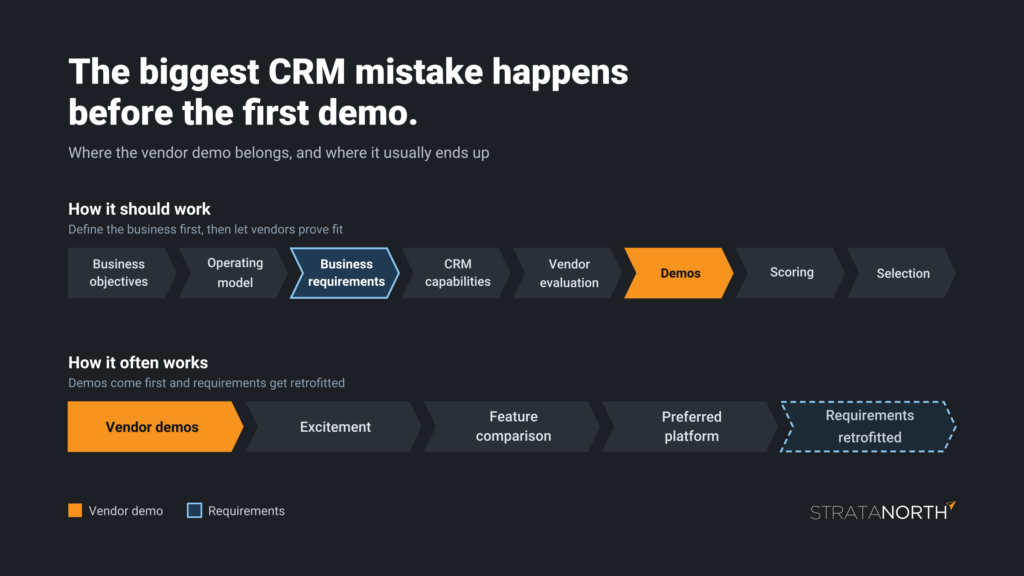
The problem is that the evaluation process gets inverted. It should generally look like this:
Business objectives → Operating model → Business requirements → CRM capabilities → Vendor evaluation → Demos → Scoring → Selection
Instead, it often looks like this:
Vendor demos → Excitement → Feature comparison → Preferred platform → Requirements retrofitted around the technology
That inversion may look subtle. It isn’t. It can change the outcome of the entire initiative.
Key Takeaways
-
Requirements describe how your organization needs to operate. They should define the CRM, not the other way around.
-
When demos come before requirements, the technology starts shaping the requirements, and the evaluation quietly shifts from what the business needs to what the platform can do.
-
Skipping requirements work during selection doesn’t eliminate it. It moves it into implementation, where every unresolved decision costs more.
Your Requirements Should Define the CRM
One of the most important points I make with clients is that requirements aren’t a list of software features. They’re a description of how the organization needs to operate, and that distinction matters enormously.
Take lead management. I’ve seen plenty of CRM evaluations where “Lead Management” appears on a spreadsheet with a checkmark from every vendor. Salesforce? Yes. Microsoft Dynamics? Yes. HubSpot? Yes. Zoho? Yes. Of course they all manage leads. But lead management isn’t really the business requirement. The real requirements are several layers beneath it:
-
Intake: Where do leads originate, who owns them when they arrive and what information must be captured?
-
Qualification: What counts as a qualified lead, and who decides? What must be present before marketing hands a lead to sales?
-
Handoff: Can sales reject a lead, and if so, does it return to marketing for more nurturing? How quickly must sales respond, and what counts as acceptance?
-
Routing: How are duplicates found and resolved? How are leads assigned by geography, industry, account ownership, product line or territory? What happens when an existing customer submits another inquiry?
-
Conversion: When does a lead become an opportunity, and what must be captured before it does?
-
Measurement: How is marketing attribution preserved across the customer journey? How are partners, referrals and other indirect sources treated? How do leaders know whether the process is working?
Suddenly, a checkbox that says Lead Management: Yes tells you almost nothing. This is exactly where many CRM evaluations start to break down.
Business Requirements and CRM Capabilities Aren’t the Same Thing
This is worth stating plainly: a business requirement describes what the organization needs to accomplish. A CRM capability describes how technology can help enable it. The two should be directly connected, but they aren’t interchangeable.
|
Layer |
What it is |
|---|---|
|
Business requirement |
The need |
|
CRM capability |
The enabler |
|
Configuration and process design |
How the capability is applied |
|
Business outcome |
The result you’re trying to achieve |
For example, a company might have this business requirement:
Sales must respond to qualified inbound leads within four business hours, with ownership automatically assigned according to territory and account ownership rules.
That one requirement could map to several CRM capabilities: lead assignment rules, workflow automation, territory management, account matching, service-level tracking, notifications and escalation, duplicate management, and reporting and dashboards.
Now you have something meaningful to evaluate. Instead of asking a vendor, “Do you support lead management?” you can ask, “Show us how your platform would support this specific requirement.” That’s an entirely different conversation, and it’s much harder to answer with a simple yes. We cover how to run that kind of test in Every CRM Vendor Says Yes.
Why Requirements Should Come Before Demos
A vendor demo is designed to sell software. It isn’t designed to discover your operating model for you. That isn’t a criticism of CRM vendors. They’re doing their job. Their sales teams know their platform extremely well, know which features look impressive and which workflows set them apart, and know how to build a compelling story around their strengths. Modern CRM platforms are impressive, too. AI assistants, automated workflows, predictive scoring, integrated marketing journeys, conversational interfaces and polished dashboards can make almost any platform look transformational.
But something happens when an organization sees those capabilities before it has defined its own requirements. The technology starts influencing the requirements. People start saying things like “We could use that,” “That would be great for marketing,” “Imagine if sales could do this,” “We definitely need AI” and “Our current system can’t do anything like that.”
Maybe those capabilities are valuable. But the evaluation has quietly shifted from “What does our business need?” to “What can this platform do?” Those are very different questions.
So Why Do Organizations Keep Starting With the Vendor?
Are businesses careless, rushing or underestimating how important CRM selection is? Generally, no. In my experience, three recurring dynamics push organizations into a vendor-first evaluation.
1. A new leader already has a preferred platform
This is extremely common. A new CRO, CMO, CIO, COO or head of sales joins after years with a particular CRM. They know it, like it and have seen it work, and perhaps implemented it successfully at their last company. Naturally they want to bring it with them.
There’s nothing wrong with that preference, and prior experience should absolutely inform an evaluation. But familiarity isn’t the same as organizational fit. The previous company may have had a different sales model, marketing organization, architecture, integration landscape, data model, regulatory environment, budget or operating maturity. The CRM that worked so well there may still be the right answer, but the evaluation should prove it.
2. The vendor gets there before the requirements do
CRM vendors are very good at selling CRM, as they should be. Once they learn an organization is considering a replacement, the sales process moves quickly. Executive briefings appear, demos get scheduled, industry specialists join, reference customers are introduced, roadmaps are presented, AI is demonstrated and pricing incentives arrive. Suddenly the organization is three meetings into a vendor evaluation before anyone has documented what the business actually needs.
The vendor hasn’t done anything wrong. The organization let the sales process get ahead of its decision process. That’s a governance problem.
3. The business is under pressure to move
This may be the most understandable reason of all. Sometimes the existing CRM is genuinely failing. Adoption is poor, sales doesn’t trust the data, marketing can’t measure attribution and customer service works from a different view of the customer. The legacy platform is nearing end of life, a contract renewal is coming, an acquisition created overlapping platforms or leadership has committed to a transformation. Or budget suddenly became available, and if the organization doesn’t act, that funding may disappear.
Those are legitimate pressures. Urgency isn’t the problem. Letting urgency eliminate the work needed to make a good decision is.
The Shortcuts Don’t Disappear. They Move Downstream.
This is one of the most important lessons I’ve learned from CRM programs. When organizations skip requirements definition, process alignment and operating-model decisions during selection, they don’t eliminate that work. They postpone it, and postponed decisions usually become more expensive ones. The questions nobody answered during evaluation surface during implementation:
|
The question during implementation |
What the team discovers |
|---|---|
|
Who owns this process? |
Sales and marketing disagree. |
|
What happens when this occurs? |
Nobody knows. |
|
Who owns this data? |
Three departments think they do. |
|
Should we configure it this way or that way? |
The business never decided. |
|
Was this capability in the original scope? |
Apparently not. |
|
Can the CRM support it? |
Yes, but now it requires customization. |
|
Does the integration support this process? |
Nobody asked. |
The organization then discovers that what looked like a technology implementation is actually an operating-model transformation that was never fully defined. Meanwhile the implementation partner is billing, the project plan is moving, executives expect milestones, users are waiting and fundamental business decisions are still being debated. That’s an expensive place to discover your requirements.
Eventually, Someone Gets Blamed
When CRM programs go badly, the natural question is whose fault it was: the CRM vendor, the systems integrator, IT, sales, marketing or executive leadership. Sometimes one of them clearly bears responsibility. Quite often, though, the failure started much earlier, when the organization selected technology before it had defined what that technology was supposed to enable.
By the time that becomes obvious, the consequences are already showing up: poor user adoption, unexpected customization, integration gaps, scope expansion, budget overruns, timeline delays, missing capabilities, data-quality problems, manual workarounds, stakeholder frustration and, in the worst cases, a failed implementation.
What I’ve Learned From Walking Into Projects After They Went Wrong
Over the past few decades, roughly 40% of my CRM advisory work has been connected in some way to troubled or failed implementations. The call usually comes after things have already gone off the rails, when someone tells a leader, “You need someone who has seen this before.”
So we come in. We assess what happened and separate technology problems from implementation, process, governance and organizational problems. We work out what can be salvaged and rebuild the roadmap. Sometimes we replace the implementation partner, reconfigure the platform or restart major parts of the program. Occasionally we find the organization selected the wrong technology in the first place.
Those engagements can be enormously rewarding when you help a company recover, but I’d much rather help an organization avoid getting there. Failed CRM programs leave scars. People get exhausted, executives lose confidence, users become cynical about the next transformation, teams blame one another, partners get defensive and budgets disappear into remediation instead of innovation. Worst of all, when the company tries again, it starts from skepticism instead of optimism.
A Better CRM Evaluation Starts Before the First Vendor Meeting
That’s why I’m so passionate about helping organizations prepare before they start talking seriously with vendors. You don’t need a 500-page requirements document, six months of consulting or a prediction of every workflow you might need in five years. But you should be able to clearly answer:
-
What business problems are we solving, and what outcomes are we trying to achieve?
-
How should our major customer-facing processes operate?
-
Where do sales, marketing and customer service need to align?
-
Which business requirements are essential?
-
What data needs to exist, and who owns it?
-
Which systems must integrate with the CRM?
-
What capabilities are required to enable those requirements?
-
What’s truly differentiating, and what’s merely interesting?
Only then should vendors show you how they’d solve those problems. If you want a structured way to get there, the 12-step readiness framework in Part 9 walks through it.
Make the Vendor Demonstrate Your Requirements
This is also why we built the CRM Vendor Capability Matrix. It’s designed to move organizations away from the generic question, “What can your CRM do?” and toward a far more useful one: “How does your CRM satisfy what our business needs?”
That change sounds small, but it shifts control of the evaluation. Your requirements, not the vendor, determine what gets demonstrated. Instead of comparing marketing presentations, you compare capabilities against a common framework. And instead of asking whether something is “supported,” you can distinguish whether it’s available out of the box, needs a partner solution, needs customization or isn’t adequately supported at all.
Suddenly the polished demo matters a little less, and the evidence matters a lot more.
Start With the Business
CRM platforms have become extraordinarily powerful. The technology available today would have seemed almost unimaginable when I started working with CRM more than two decades ago. But the basic sequence for making a good technology decision hasn’t changed much: understand the business before you select the technology. Define how you want to operate, identify the problems you’re trying to solve, establish the requirements, translate them into capabilities, and then evaluate which technology best enables them.
That’s the thread running through this entire series, from testing what a vendor’s yes really means, to holding your implementation partner accountable, to getting your data and processes ready for AI, to finding the small set of capabilities your business truly depends on. The goal isn’t to select the CRM with the longest feature list, the best demo or the most impressive AI story. The goal is to select the CRM that best enables the business you’re trying to build. Start there, and then let the technology prove that it belongs.
Get Your Requirements Ready Before the First Demo
StrataNorth helps organizations define their requirements, align stakeholders and run vendor evaluations on their own terms, so the demos answer your questions instead of setting the agenda. We don’t resell CRM software, so our only stake in the outcome is that it works for your business.
Start with the free CRM Readiness Assessment to see how prepared you are for an evaluation, and use the CRM Vendor Capability Matrix to make every vendor demonstrate your requirements. When you want an independent perspective, book a CRM exploration call or explore our CRM advisory services.
Start with the business. Then let the technology prove it belongs.
Listen: The CRM Advantage, Episode 1, Building the Foundation: CRM Strategy Before Software
Next in this series: Part 2: Which CRM Should We Buy? Why the Answer Depends on Your Operating Model