
Every generation of CRM promised simplicity. Here’s where the complexity went instead.
Part 7 of 9 in our CRM Selection series.
I’ve worked with CRM technology since 2000. In that time I’ve taken part in more than 50 CRM advisory engagements and more than 280 CRM implementations, so I haven’t watched CRM evolve from the sidelines. I’ve lived through several generations of it.
I remember when CRM meant servers in a data center, thick clients, database administrators, overnight batch jobs, custom integrations and carefully planned upgrades. I remember sitting with executives in the early days of SaaS, explaining why they might someday want to move critical business applications outside their own four walls. I remember when marketing automation collided with traditional CRM and a “lead” stopped being just a record. It had a score, a source, a campaign history, digital behavior, a nurture status and an increasingly complicated journey before sales ever saw it. I watched APIs turn CRM from an application into part of an ecosystem, and I watched Customer 360 become an aspiration, customer data platforms become a category and data platforms become part of the CRM conversation.
Now I’m watching AI promise to transform the industry all over again. After hundreds of implementations, one observation has become clear to me:
Every generation of CRM technology has eliminated certain kinds of complexity while introducing entirely new ones. CRM complexity hasn’t disappeared. It has migrated.
Understanding where that complexity has moved may be one of the most useful things you can do before selecting your next CRM platform. In You Chose the CRM. Is Your SI Delivering What You Bought?, we looked at making sure the implementation delivers what you selected. This post steps back and explains why that work keeps getting harder with each generation of technology, and why AI raises the stakes again.
Key Takeaways
-
Each generation of CRM, from on-premises to SaaS, marketing automation, APIs, Customer 360 and now AI, removed one kind of complexity and moved it somewhere less visible.
-
The hardest CRM questions have stayed the same for 26 years. They are business questions about ownership, qualification, process and data, expressed through technology.
-
More powerful technology doesn’t mean a simpler transformation. The more a platform can do, the more it matters that you’ve decided what you want it to do.
Where the Complexity Went
|
Era |
What got easier |
Where the complexity moved |
|---|---|---|
|
On-premises CRM |
A structured way to capture customer information and manage the processes around it |
Infrastructure, upgrades and custom code |
|
SaaS |
No servers to buy, faster provisioning, more frequent releases |
Architecture, integration, configuration, licensing, data and governance |
|
Marketing automation |
Orchestrating customer engagement and behavior |
Business rules, process definitions and departmental alignment |
|
APIs |
Connecting systems |
Governing an interconnected architecture |
|
Customer 360 and CDPs |
Access to more customer data |
Identity, ownership and governance |
|
AI |
Interpreting and acting on information |
Data quality, security, context, process maturity and governance |
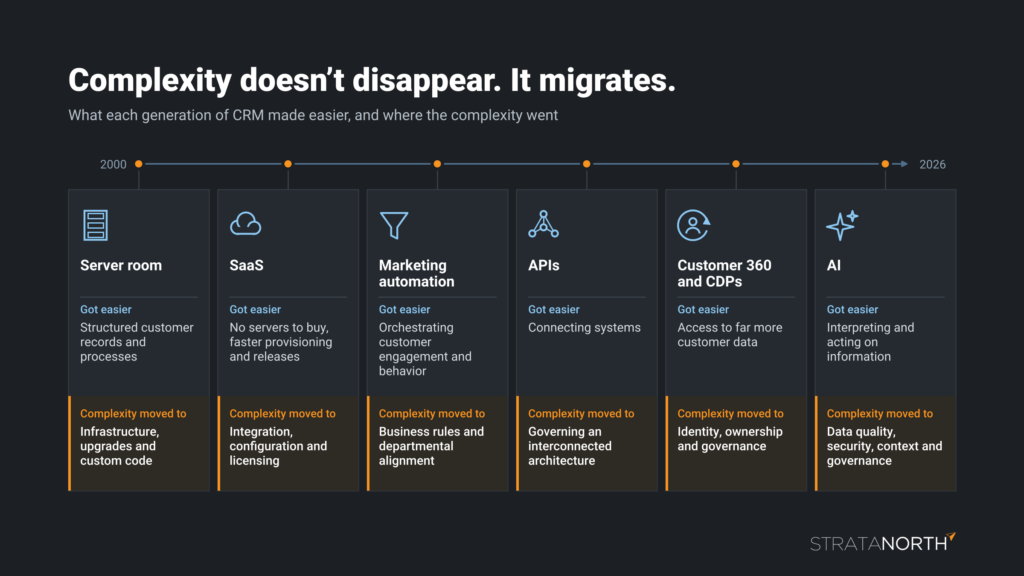
Timeline of how CRM complexity evolved since the 2000s.
The 2000s: When You Could See the Complexity
Servers, databases, storage, networking, custom code, scheduled jobs, middleware, desktop software, separate development, test and production environments, and cables. Lots of cables.
Walk into the infrastructure room behind a significant enterprise application in the early 2000s and you could practically see the technology: racks of equipment humming, status lights blinking, backup tapes, network switches, storage arrays, and whiteboard diagrams that only three people in the company fully understood. Somewhere in that environment lived your CRM system.
Looking back at those systems today feels a bit like looking at the computers that helped put astronauts on the moon and then looking down at the phone in your hand. At the time, though, they were remarkable. CRM gave organizations a structured way to capture information about prospects and customers and manage the processes around them.
The tradeoff was enormous technical overhead. An implementation was never just “let’s configure our sales process.” It also raised questions like these:
-
Where are we putting the servers, and how much storage do we need?
-
How are we handling backups, and which database platform are we using?
-
How are remote offices connecting, and how do we deploy the client software?
-
What happens when we upgrade, and which customizations will break?
-
How do we integrate CRM with ERP and get website data into CRM, and who monitors those integrations?
-
What happens when the overnight synchronization job fails at 2:00 a.m.?
And one of my personal favorites: who is willing to touch the custom code written three years ago by the consultant who no longer works here? That was CRM complexity in the early days. You could walk into the server room and point at a good part of it.
SaaS Didn’t Eliminate Complexity. It Relocated It.
Salesforce was founded in 1999 around the idea of delivering CRM as a service over the internet. That seems obvious today, but at the time it was disruptive.
I remember sitting across from CIOs and IT leaders and suggesting they consider moving applications they had spent years protecting inside their own data centers onto infrastructure they didn’t own. You could sometimes see the reaction before they said anything: “You want me to put my customer data… where?” Back then you often had to explain what “the cloud” was before you could explain why anyone would want it. There were real questions about security, control, performance, availability, data ownership, integration and customization, and the biggest one was understandable: why would I give up infrastructure I control for infrastructure I don’t?
I got plenty of skeptical looks and plenty of rejection. Then the conversation changed remarkably quickly. Organizations that had been hesitant wanted to understand SaaS, and CIOs who had questioned the model started asking how fast they could evaluate it. I remember working weekends because of the demand to understand what this new model could mean.
The SaaS proposition was compelling: no CRM servers to buy, no local software deployment, less infrastructure to maintain, faster provisioning, more frequent releases, access from almost anywhere, subscription pricing, and configuration instead of endless customization. It solved many real problems.
But something happened that I don’t think the industry fully appreciated at first. When we removed infrastructure friction, we made it much easier to add capability. Platforms expanded, third-party app ecosystems grew, APIs improved, integrations multiplied, release cycles sped up and departments began buying their own cloud applications. CRM was no longer just connected to ERP. It might now connect to email, the website, marketing automation, customer service, telephony, ecommerce, analytics, contract management, document generation, quoting, billing, identity platforms and half a dozen specialized SaaS tools.
The blinking lights disappeared from the server room, and the complexity moved into architecture, integration, configuration, licensing, data and governance. Unlike the old server room, most of it was invisible.
Marketing Automation Made the Business Rules the Hard Part
This was probably my favorite era. The convergence of CRM and marketing automation felt like going from black-and-white television to color. We weren’t just managing accounts, contacts and opportunities anymore. We were orchestrating behavior.
A prospect downloads a white paper, and the score changes. The score crosses a threshold, and the prospect moves into a different nurture stream. Another activity triggers an alert, a demographic attribute changes routing, a geographic rule assigns ownership, inactivity sends the prospect backward and a qualifying action sends them forward. Eventually marketing hands the lead to sales, and sales accepts it or doesn’t.
If sales rejects it, where does it go? Back to marketing? Does the score change? Does the nurture sequence restart? Should the rejection reason decide which campaign receives it? Something that sounds simple, “send qualified leads to sales,” can represent dozens of business rules.
I worked across that transition with platforms including Eloqua, Marketo and Neolane and the expanding Salesforce and Microsoft ecosystems, and on lead engines and lead master-data management. That’s when I began to see something that has shaped how I think about CRM ever since:
The technology usually wasn’t the hardest part. Defining what the business wanted the technology to do was.
Ask ten executives what a qualified lead is and you may get ten answers. Marketing might define it by engagement, sales by buying intent, finance by revenue potential and operations by geography or capacity. The technology could automate almost any definition we gave it. The difficult part was agreeing on one, and that lesson has survived every generation of CRM since.
CRM Stopped Being an Application and Became an Ecosystem
As platforms matured, their boundaries kept expanding: sales, marketing, customer service, field service, commerce, configure-price-quote (CPQ), partner management, customer portals, analytics, customer data, journey orchestration, contract management, revenue operations, integration, low-code development and, eventually, AI. The term CRM started to feel inadequate for what these platforms had become.
Consider something as simple as displaying an account. What exactly is an account today?
|
Account information |
Where it may come from |
|---|---|
|
Identity |
CRM |
|
Orders |
ERP |
|
Invoices |
The financial system |
|
Service cases |
A separate service cloud |
|
Digital behavior |
Marketing automation |
|
Web purchases |
Ecommerce |
|
Product usage |
Telemetry |
|
Contracts |
A contract lifecycle management platform |
|
Consent preferences |
Yet another system |
|
Support conversations |
Email, chat and telephony |
Somewhere in the middle of all this, someone inevitably asks, “Can’t we just have a 360-degree view of the customer?” You can, but Customer 360 isn’t a screen. It’s an architecture. It forces decisions about identity, integration, master data, latency, security, ownership and reconciliation.
Which system owns the customer name? Which owns the address? When ERP says “ABC Corporation” and CRM says “ABC Corp.,” is that the same customer? What about subsidiaries, households, multiple billing entities, duplicate contacts with different email addresses, customers operating in several countries, or anonymous web visitors who later identify themselves? Who wins when two systems disagree?
The prettier the Customer 360 screen gets, the easier it is to forget how much machinery is running underneath it.
APIs Made Integration Easier to Build and Harder to Govern
Modern APIs made integrations that once required significant custom engineering dramatically easier. That was a major step forward, but once again, lowering the barrier increased consumption. When integrations were difficult and expensive, companies were selective. When APIs made them easy, organizations integrated everything.
That raised a new class of questions. Who owns the interface? What happens when an API changes, and how do we monitor failures? Do we need real-time, near-real-time or batch integration? When CRM is available but ERP isn’t, do we retry, queue the transaction or alert someone? Which system is authoritative, how do we prevent duplicates, and what happens when a customer changes something in two systems at once? How do we secure machine-to-machine access?
The integration became easier to build. The integration architecture became harder to govern. That distinction matters.
Customer Data Platforms Exposed the Identity Question
As organizations accumulated more customer information, another problem emerged. We had plenty of data, but we didn’t necessarily have a coherent customer. Organizations wanted a unified view across CRM, marketing, ecommerce, service, mobile, web, ERP and other sources, and customer data platforms (CDPs) promised to resolve that fragmentation.
They can help. But once again, the technology exposed business questions hiding underneath. Who is the customer? That sounds like a silly question until you try to answer it across twenty systems. Is a customer an individual, a household, a company, a billing entity, a location or a parent corporation? Can one person belong to multiple accounts? What counts as a duplicate, which email address is primary, and which system can overwrite another? What information can AI use, and what information should it use?
The more sophisticated the technology became, the more data architecture and governance mattered.
AI Raises the Stakes on the Fundamentals
That brings us to today. Once again, the industry is promising a fundamental transformation, and this one may end up larger than all the others. Modern platforms offer generative AI, predictive intelligence, conversational interfaces, automated summaries, recommended actions, content generation, autonomous agents and AI-driven workflows. Microsoft now builds Copilot and agent capabilities into Dynamics 365 Sales, and Salesforce has moved aggressively toward an agent-centric CRM architecture.
The demos can be extraordinary. Ask the AI to summarize an account and tell you what to do next, and within seconds you get a well-written answer. Twenty-five years ago that would have looked like science fiction. After watching several generations of CRM arrive with promises of simplification, though, I find myself asking a different question: what exactly is the AI summarizing?
AI doesn’t eliminate the underlying CRM disciplines. In many cases it makes them more important.
|
If your CRM has… |
AI works with… |
|---|---|
|
Meaningless opportunity stages |
Meaningless stages to analyze |
|
Duplicate contacts |
Duplicate identities |
|
Activities that aren’t captured |
An incomplete history |
|
Inconsistent product information |
Inconsistent context |
|
Wrong account hierarchies |
The wrong relationships |
|
Service history that isn’t integrated |
Only part of the customer |
|
Poorly designed permissions |
A new category of risk |
If the organization hasn’t agreed on what a qualified lead means, adding an AI agent doesn’t settle the argument. It gives the unresolved argument more computing power.
AI dramatically increases what CRM can do, and it also increases the value of getting the fundamentals right. We look at why in AI in CRM: Why Data Quality and Business Readiness Still Matter, and at how to prepare in the 12-step readiness framework that closes this series.
The Economics Changed Along With the Technology
CRM pricing has become more layered because CRM itself has become more layered. It’s increasingly hard to talk about “the cost of CRM” as if it were a single per-user license. A modern CRM environment may include core CRM licenses, marketing automation, customer service, analytics, integration, data platforms, storage, CPQ and revenue management, industry-specific capabilities, sandboxes, security, customer portals, AI consumption or credits, third-party applications, implementation services, managed services and ongoing administration.
Current pricing shows how wide that spectrum has become. Microsoft lists Dynamics 365 Sales plans from $65 to $150 per user per month. In September 2026, Salesforce introduced new Sales Cloud editions at $195, $395 and $550 per user per month, each bundling a pool of AI credits for the organization, with further usage billed on top. The per-user license is still there, but AI consumption is now its own line in the budget.
That doesn’t mean CRM has simply become more expensive. It means you’re often buying something far broader than what we called CRM twenty years ago. A 2002 CRM license and a 2026 enterprise customer platform are barely comparable products. One helped organize customer relationships. The other may help run a large part of the customer-facing business. That’s why total cost of ownership belongs in your evaluation alongside capability, and why we built it into the CRM Vendor Capability Matrix.
So Did the Implementation Team
Implementation teams evolved alongside the platforms. Early in my career, a CRM project involved a fairly understandable set of roles: project manager, business analyst, database specialist, infrastructure resources, developers, trainers and functional consultants.
On a large CRM transformation today you may find enterprise, solution, integration, data and security architects; CRM functional consultants; marketing automation specialists; data engineers; AI specialists; change management teams; UX designers; developers; QA engineers; DevOps resources; product owners; scrum masters; business analysts; data governance teams; and specialists for individual parts of the ecosystem.
The technology became easier to consume. The ecosystem became harder to orchestrate. It’s also why who you hire to implement matters as much as what you buy, which we covered in You Chose the CRM. Is Your SI Delivering What You Bought?
The Questions That Haven’t Changed
This is the strangest part of working in CRM for more than 26 years. Almost everything has changed: the infrastructure, user interfaces, deployment models, programming languages, integration technologies, licensing models, release cycles, data architectures, vendors and certainly the terminology. Now AI is changing the interaction model itself.
But when I walk into a CRM program today, I still hear versions of the same questions I heard decades ago:
-
What is a qualified lead, and when does marketing hand it to sales?
-
What happens when sales rejects a lead?
-
Who owns the customer, and who owns the data?
-
What information does sales have to enter, and when does an opportunity advance?
-
How should territories work?
-
Which processes should be standardized, and what should we automate or leave alone?
-
Who is responsible for adoption?
-
What does success look like?
Those questions survived client/server CRM, SaaS, marketing automation, APIs, Customer 360 and CDPs, and I expect they’ll survive AI. They were never primarily technology questions. They were business questions expressed through technology. That’s the thread I’ve seen running through hundreds of implementations.
Complexity Doesn’t Disappear. It Migrates.
On-premises CRM made organizations responsible for infrastructure. SaaS largely removed that burden but made it far easier to multiply applications and capabilities. APIs made systems easier to connect and created increasingly interconnected architectures. Marketing automation made customer engagement more sophisticated and exposed weaknesses in process definitions, data and organizational alignment. Customer 360 made more data accessible and amplified identity, governance and ownership challenges. AI makes information far easier to interpret and act on, and makes data quality, security, context, process maturity and governance even more consequential.
I’ve watched that complexity move from the server room to the cloud, to the integration layer, to the customer journey, to the data architecture, and now into the AI and agentic layer. I still find it exciting. I was excited when we stopped installing CRM clients on desktops, when SaaS challenged the data center, when marketing automation let us orchestrate journeys we could barely imagine a few years earlier, and when APIs opened the platforms. I’m excited about what AI will do next.
Hundreds of implementations have also taught me not to confuse more powerful technology with a simpler transformation. Often the opposite is true. The more capable these platforms become, the more important it is to understand your processes, your data, your architecture, your people and the outcomes you’re trying to achieve.
Twenty-six years later, the hardest CRM question still isn’t “What can the technology do?” The technology can do an astonishing amount. The harder question is “What exactly do we want it to do for our business?” That question has followed us from the server room all the way to AI.
Know Where Your Complexity Will Land Before You Buy
StrataNorth helps organizations evaluate CRM platforms, define business requirements, assess readiness and plan for the architecture, data and governance work that comes with modern CRM. We don’t resell CRM software, so our advice starts with how your business needs to operate.
Start with the free CRM Readiness Assessment to see where your foundations stand, and use the CRM Vendor Capability Matrix to compare platforms against your own requirements and costs. When you want an independent perspective, book a CRM exploration call or explore our CRM advisory services.
The technology will keep changing. The business questions underneath it won’t.
Listen: The CRM Advantage, Episode 1, Building the Foundation: CRM Strategy Before Software
Previous in this series: Part 6: You Chose the CRM. Is Your SI Delivering What You Bought?
Next in this series: Part 8: AI in CRM: Why Data Quality and Business Readiness Still Matter