
Why the biggest advance in CRM in decades will expose its oldest weaknesses.
Part 4 of 9 in our CRM Selection series.
I’ve spent more than 26 years helping organizations evaluate, select, implement and improve Customer Relationship Management (CRM) platforms. In that time, CRM has grown from contact management and sales force automation into platforms that connect sales, marketing, service, operations, finance and nearly every function that touches a customer. Cloud changed how CRM was deployed. Marketing automation changed how companies engage customers. Analytics and integration changed what they could know about them. Nothing has captured the industry’s attention like artificial intelligence.
I’m a strong believer in AI, and I think its impact on CRM will be profound. What concerns me is the assumption riding along with the enthusiasm. We’re putting some of the most sophisticated technology ever built into business environments that still haven’t fixed the problems they’ve struggled with for decades, and many organizations expect AI to fix those problems for them. It won’t, at least not on its own.
Key Takeaways
-
AI can summarize, recommend and increasingly act inside your CRM. It can’t decide how your business defines a customer, a qualified lead or an account owner.
-
Because AI can act on bad data instead of just reporting it, the cost of weak data, unclear processes and loose governance rises.
-
Start with a bounded, measurable use case and expand autonomy as trust is earned. Readiness is a starting point to assess, not a finish line to wait for.
The AI Shift in CRM Is Real
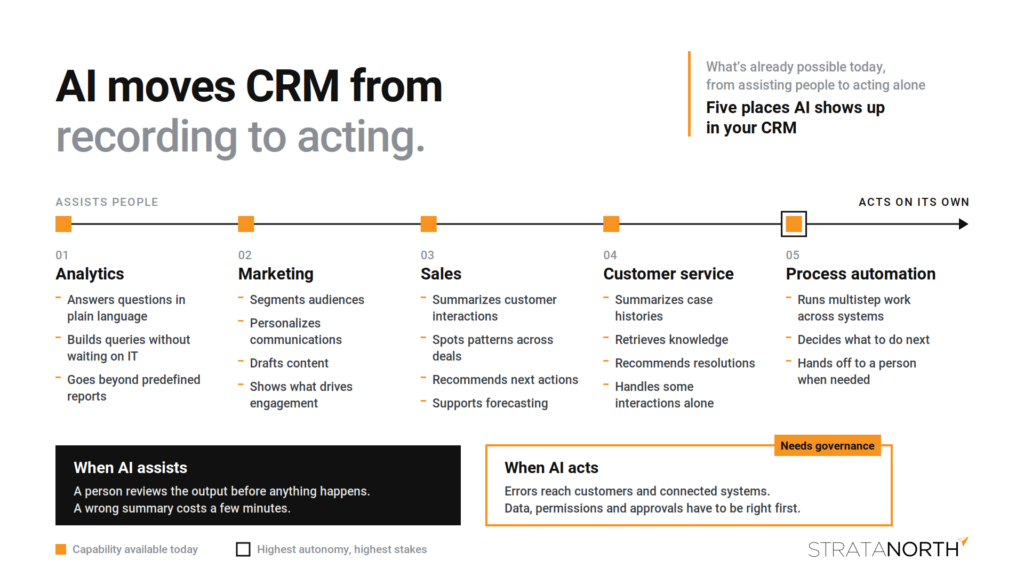
For decades, CRM depended on people. People entered information, systems organized it, and people made decisions based on what the systems reported. Automation improved over the years, but that model held. AI changes it. Here is what’s already possible:
|
Function |
What AI can do today |
|---|---|
|
Sales |
Summarize customer interactions, spot patterns across opportunities, recommend next actions, support forecasting and cut the administrative work reps have complained about for years |
|
Marketing |
Support segmentation, personalize communications, generate content, analyze campaign performance and show which activities drive engagement |
|
Customer service |
Summarize case histories, retrieve knowledge, recommend resolutions and handle some interactions without a representative at every step |
|
Analytics |
Let business users ask questions in plain language instead of relying on predefined reports or a technical team to build queries |
|
Process automation |
Run multistep work across systems through AI agents that use business context to decide what to do and when a person needs to step in |
The part that excites me most isn’t the generated email or the meeting summary. It’s the chance to move CRM from a system that records customer activity to one that helps an organization understand, anticipate and respond to customer needs. But what the technology can do and what a given organization is ready to do with it are two different things.
The Magical Data-Fix Myth
One of the most dangerous assumptions in the current wave is that advanced models and autonomous agents can bypass, repair or make irrelevant years of poor CRM data. I call it the magical data-fix myth, and it usually sounds like this:
Our customer data is fragmented. We have duplicates. Sales doesn’t keep opportunities up to date. Marketing has its own records, and service runs in another system. But with AI, we’ll finally make sense of all of it.
There’s some truth in it. AI can flag duplicates, detect anomalies, classify unstructured information, enrich some data and speed up cleanup. Those are valuable capabilities, but flagging a problem isn’t the same as resolving it correctly.
Take a common scenario. A company has three records that may represent the same customer: one for the parent organization, one for a regional subsidiary, and one a sales rep created under a different company name. AI may correctly spot the similarity. Whether to merge them depends on how the business defines a customer, manages corporate hierarchies, assigns account ownership, structures contracts, reports revenue and handles regional relationships. Those are business decisions. If an AI agent consolidates the records without understanding them, a data-quality “fix” can cause problems downstream in territories, account ownership, contracts, reporting and customer communications.
AI can find inconsistencies. It can’t decide the business rules, relationships and responsibilities that give your data meaning.
Duplicates are the easy example. The harder ones look like this: opportunity stages that mean different things to different sales teams, a “qualified lead” with no consistent definition, the same customer in CRM, ERP, ecommerce and service platforms with conflicting details, and nobody who can say which system owns a given field. AI doesn’t make those questions go away. It makes answering them more urgent.
We’ve Been Here Before
Every generation of CRM technology arrived with the same hope. Organizations moving to the cloud expected the migration to fix long-standing operational issues. More sophisticated marketing automation was supposed to bring better leads and higher conversion. More accessible analytics was supposed to give executives clear visibility into customer performance.
Each delivered real value. The organizations that struggled were usually the ones that underestimated the work outside the technology: defining processes, establishing ownership, standardizing information, aligning departments, managing change and holding people accountable for how the system was used. Better technology didn’t make those problems disappear. Often it just made the cost of ignoring them more visible.
AI follows the same pattern with one important difference. Traditional CRM needed a person to interpret information and start an action. AI can increasingly do both on its own.
An inaccurate report might lead a manager to a questionable decision. An AI workflow acting on inaccurate information can send the wrong customer communication, misclassify opportunities, recommend the wrong action or push errors across connected systems. The risk isn’t uniform. A meeting-summary assistant is very different from an agent authorized to change customer records or execute transactions. But the more autonomy you grant, the more your data, processes, permissions and governance matter. The faster a system can act, the more important it is that it understands your business correctly.
Your CRM Vendor Has a Roadmap. Do You Have a Strategy?
I want to be fair to the vendors. The innovation coming from the major CRM platforms is extraordinary, and much of that investment will create real value for customers. It’s also true that vendors have a financial interest in accelerating AI adoption through premium licenses, consumption charges, expanded platform usage, new products and deeper dependence on their ecosystems. There’s nothing wrong with that. Vendors are businesses, and innovation costs money.
The problem starts when an organization’s AI strategy becomes indistinguishable from its vendor’s product roadmap. I’ve always believed you should define what you need technology to accomplish before evaluating what a vendor wants to sell you. With AI, that matters even more.
A demo can show an assistant summarizing an opportunity, flagging an at-risk account or completing a workflow on its own. Demos run in controlled environments with carefully structured scenarios and data. Your environment has incomplete records, legacy processes, exceptions, inconsistent definitions, competing departmental priorities and integrations that have grown over years. The question isn’t whether the AI can do something impressive in a demo. It’s whether it can do that task reliably, securely, economically and consistently inside your business, and whether that task is worth automating at all.
We covered how to test demo claims against your own scenarios in Every CRM Vendor Says Yes. The same discipline applies to AI features. Write them into your requirements and score them alongside everything else in the CRM Vendor Capability Matrix.
What AI Can’t Solve for You
AI can help with each of these, but none of them gets resolved without a decision from the business and someone accountable for it.
-
Unclear processes. If two sales teams define a qualified opportunity differently, AI may learn both definitions. It can’t choose which one becomes the standard.
-
Fragmented customer information. Customer data lives across ERP, ecommerce, marketing automation, service, finance and outside data providers. AI can help connect it, but you still need clear definitions, an integration strategy and authoritative sources.
-
Weak data governance. Who owns customer information, who can change it, which system is authoritative, what validation applies and how exceptions are handled are policy decisions. AI can support governance, but a person sets the rules and owns the outcome.
-
Inconsistent adoption. If reps don’t trust the CRM or aren’t accountable for keeping it current, AI may reduce their manual effort, which helps. It won’t fix the incentives, training and leadership behind the problem.
-
Undefined outcomes. Better forecast accuracy, faster service resolution, higher conversion, stronger retention and less administrative work are very different goals. Measure AI against the one you chose, not against how many features you’ve switched on.
New Risks That Deserve Serious Attention
Traditional CRM readiness focused on requirements, data, integration, process design, security and adoption. Those still matter. AI adds another layer:
|
Risk |
Why it matters |
What to put in place |
|---|---|---|
|
Accuracy and reliability |
Generative AI can produce output that is convincing and wrong. A well-written summary isn’t necessarily a correct one. |
Evaluation criteria, testing, and a way to catch and correct errors |
|
Security and privacy |
AI capabilities may reach data across several systems. |
A clear view of what data models and agents can see, how permissions are enforced and how information is retained |
|
Autonomous actions |
Recommending an action and executing it carry very different levels of risk. |
Defined boundaries, approval steps, audit trails, and the ability to stop or reverse actions |
|
Transparency and accountability |
AI recommendations can shape pricing, customer prioritization and service treatment. |
A named owner for AI-influenced decisions and a way to explain or challenge them |
|
Cost and dependency |
Pricing can include added licenses, usage charges, data services, integration, monitoring and support. |
A total cost of ownership view, not just the subscription price |
|
Change management |
AI changes how people work with CRM and who is responsible for what. |
Training and adoption planning that head off confusion, overreliance and resistance |
None of this is a reason to avoid AI. It should shape how you introduce, govern and expand it.
Six Dimensions of CRM and AI Readiness
Before investing heavily in AI-enabled CRM, assess where you stand in six areas. This doesn’t mean a multiyear transformation before you’re allowed to use AI. It means an honest view of your starting point and a disciplined way to manage risk.
1. Business strategy and measurable outcomes
Start with the business problem, not the AI feature. Define the outcome you want to improve, its current baseline and how you’ll measure success. Prioritize use cases by business value, feasibility and risk.
2. Process maturity and ownership
Document the processes AI will support or influence, along with their owners, decision points, exceptions and approval requirements. Don’t automate a process just because it exists. Decide first whether it should work that way.
3. Data quality and governance
Assess completeness, accuracy, consistency, duplication, lineage and accessibility. Set authoritative sources, data owners and cleanup priorities. Not every record needs to be perfect. The data behind a specific use case needs to be reliable enough for that purpose.
4. Technology architecture and integration
Map how CRM connects to ERP, marketing, ecommerce, service, analytics and other relevant systems. Confirm that AI can reach the right information securely and that the information is current enough to act on. Don’t assume a vendor’s native AI resolves your integration or architecture limits.
5. AI governance, security and controls
Decide what AI may recommend, what it may execute and what needs human approval. Put testing, monitoring, access controls, audit logging, incident handling and accountability in place, scaled to the consequences of a failure.
6. People and adoption
Prepare employees for new workflows and responsibilities, be clear about what AI can and can’t reliably do, and give someone ownership of ongoing performance and improvement. Technology adoption and organizational adoption are not the same thing.
Our free CRM Readiness Assessment covers the organizational side of this list, including executive sponsorship, administration and training, in 12 questions. It’s a quick way to find your weakest foundation before you add AI on top of it.
Start Small, but Start Deliberately
You don’t need to fix every historical CRM issue before experimenting with AI. AI can even speed up the readiness work itself through data profiling, documentation, process discovery, knowledge organization and spotting inconsistencies.
Pick a bounded use case, set a baseline, test with representative business data and measure the results. AI-generated service case summaries that employees review before use are a good example. They let you evaluate data quality, output accuracy, permissions, user experience and productivity gains without authorizing autonomous, customer-facing actions on day one. As confidence grows, expand into more sophisticated workflows.
Readiness shouldn’t become an excuse for inaction, and enthusiasm shouldn’t become an excuse to drop discipline.
The Most Important CRM Question Hasn’t Changed
After more than two decades in CRM, I keep coming back to one question: Have we clearly defined how our business needs to operate, or are we expecting the technology to define it for us?
It mattered for basic sales force automation, for the move to cloud CRM, and for marketing automation and advanced analytics. It matters more now. The organizations that get the most from AI-enabled CRM won’t be the ones with the most sophisticated models, the most agents or every new feature turned on. They’ll be the ones that understand their customers, run sound processes, keep reliable data, assign clear accountability and apply AI where it creates measurable value.
The technology is extraordinary, and the opportunity is real. There’s still no shortcut around understanding your own business.
Is Your Organization Ready for AI-Enabled CRM?
StrataNorth helps organizations evaluate CRM platforms, define business requirements, assess readiness and make informed technology decisions. We don’t resell CRM software and we have no AI add-ons to sell you, so our advice starts with your business instead of a vendor’s roadmap.
Whether you’re evaluating a new CRM, reconsidering an existing implementation or working out where AI fits in your customer strategy, start with the CRM Readiness Assessment to see where your foundations stand. When you want an independent perspective, book a CRM exploration call or explore our CRM advisory services.
AI has changed what CRM can do. It hasn’t changed your responsibility to get the fundamentals right.
Related reading: Every CRM Vendor Says Yes, The Highest-Scoring CRM Isn’t Necessarily the Right CRM and You Chose the CRM. Is Your SI Delivering What You Bought?
Listen: The CRM Advantage, Episode 1, Building the Foundation: CRM Strategy Before Software