The CRM Capability Matrix produces evidence. It doesn’t make the decision for you.
Part 2 of 9 in our CRM selection series.
A good CRM evaluation should produce something far more useful than a winner at the bottom of a spreadsheet. It should give your organization the evidence to understand why one platform may be a better fit than another, what compromises come with that choice, and what it will take to implement and operate it successfully.
For a smaller organization with straightforward requirements, a well-constructed CRM Capability Matrix may be all you need: define your requirements, establish their importance, evaluate vendors consistently and compare the results. As the organization, requirements and implementation become more complex, the score becomes only one part of the decision.
In Every CRM Vendor Says Yes, we explained how to build a CRM Capability Matrix that scores vendors on how they deliver each requirement, not just whether they can. This post picks up where that one ends: what to do with the scores once you have them.
Key Takeaways
-
A capability score is evidence, not a decision. A vendor with a lower score can still be the better fit for your business.
-
How a requirement is delivered, and how much it matters to your business, changes what a score really means.
-
Capability fit is one of ten dimensions to weigh, alongside architecture, security, licensing, total cost of ownership and user adoption.
The Highest Score Doesn’t Automatically Win
Imagine that after completing your evaluation, three CRM vendors receive the following scores, each shown as the vendor’s weighted total as a percentage of the highest possible score:
-
Vendor A: 91%
-
Vendor B: 87%
-
Vendor C: 74%
At first glance, Vendor A looks like the obvious choice. But suppose it needs significant customization to satisfy several of your most critical requirements, while Vendor B supports them through configuration and integrates more naturally with your existing technology stack. Vendor A may also require a more expensive licensing tier to reach capabilities included in Vendor B’s standard edition.
Vendor B might have a stronger implementation partner ecosystem in your industry, a simpler integration architecture or a significantly lower five-year total cost of ownership (TCO). Or Vendor A may have the strongest functionality today, while Vendor B better fits where the organization expects to be three years from now. Suddenly, that four-percentage-point gap matters much less.
The score should help inform the decision. It should never become the decision.
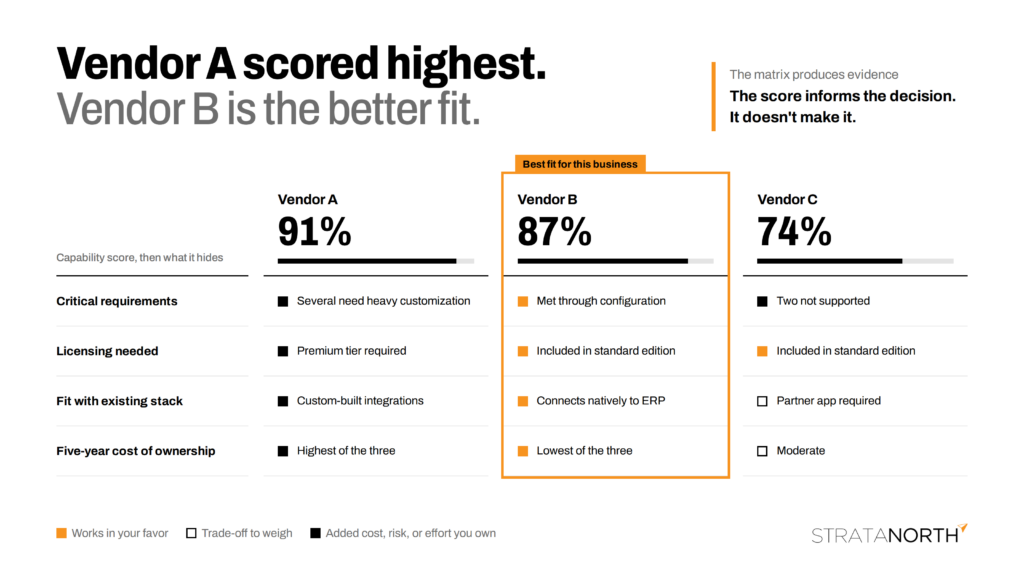
Vendor A scores 91% but needs customization, a premium license and custom integrations; Vendor B scores 87% and is the better fit.
Look Beneath the Score
The Capability Matrix scores each requirement by how it is delivered: out of the box, through a partner solution, through customization, or not at all. (We break down the scoring method in Every CRM Vendor Says Yes.) That distinction is what makes the overall score worth questioning.
A CRM that satisfies 95% of your requirements through extensive customization can introduce more cost, technical debt and operational complexity than one that satisfies 90% primarily through native functionality.
Not Every Requirement Should Count Equally
Raw scores can also mislead because not every capability matters equally to your business. A sophisticated marketing automation feature might be useful, but your organization could operate well without it. A specific integration with your ERP (enterprise resource planning) system, on the other hand, might be essential. That is why requirements should be prioritized before vendors are evaluated.
A vendor that struggles with ten low-priority requirements but performs exceptionally well on the capabilities that differentiate your business tells a very different story than its percentage score suggests. Conversely, a vendor can collect points across dozens of “nice to have” capabilities while falling short on two or three requirements that are fundamental to your operating model. Averages can hide important problems.
The goal isn’t to find the CRM with the most capabilities. It is to find the CRM whose capabilities best match the requirements that matter most to your organization.
Capability Fit Is Only One Dimension of the Decision
Once capability scoring is complete, the evaluation should broaden. Capability fit is one of ten dimensions a sound CRM decision should weigh, and each answers a different question.
|
Dimension |
The question it answers |
|---|---|
|
Capability fit |
Does the platform support the business processes we actually need? |
|
Architecture |
Does the platform fit within our broader technology environment and strategy? |
|
Integration |
How easily can it connect to ERP, marketing automation, ecommerce, customer service, data platforms and other critical systems? |
|
Security and governance |
Can it satisfy the organization’s access, privacy, compliance, audit and data governance requirements? |
|
Data |
How difficult will migration be, and how well does the platform support our future customer data strategy? |
|
Implementation complexity |
How much configuration, customization, integration and organizational change will be required? |
|
Licensing |
What is included, what requires premium editions or add-ons, and how might costs change as adoption expands? |
|
Total cost of ownership (TCO) |
What will the platform realistically cost over three, five or seven years once licensing, implementation, integrations, support, administration and ongoing enhancements are included? |
|
Vendor and ecosystem |
Is there a mature implementation and support ecosystem to support the organization after go-live? |
|
Adoption |
Will the people expected to use the CRM actually embrace it? |
In regulated industries, security and governance carries extra weight. For healthcare organizations, it includes whether the vendor will sign a HIPAA business associate agreement. Life sciences teams may need validated systems for regulated electronic records, and financial firms face their own recordkeeping and audit obligations.
A vendor can perform extremely well in one dimension and poorly in another. That is why selecting a CRM should be a multi-dimensional business decision, not a feature competition.
Requirements Come Before Scoring
There is an uncomfortable truth about sophisticated evaluation models: a sophisticated scoring model applied against poorly defined requirements produces a precisely calculated bad answer. The quality of the evaluation can never exceed the quality of the requirements feeding it.
This is where requirements workshops become valuable. Before vendors are scored, stakeholders should agree on what the organization needs, why it needs it and how important each requirement is. (We covered why requirements should come before vendors in Every CRM Vendor Says Yes.) That process often exposes disagreements that have little to do with CRM technology:
-
Sales may want greater flexibility.
-
Marketing may want stronger automation and customer segmentation.
-
Customer service may prioritize case management and a unified customer history.
-
IT may prioritize architecture, security, integration and maintainability.
-
Finance may focus on licensing and long-term cost.
-
Leadership may care most about adoption, scalability and business outcomes.
Those perspectives need to be reconciled before the vendor demonstrations begin, not after proposals arrive. Otherwise, the organization risks evaluating vendors against requirements that were never truly agreed upon.
Once requirements are agreed, they should drive the vendor demonstrations too. Scripted scenarios turn each demo from a sales presentation into an evidence-gathering exercise. We cover how to structure them in Every CRM Vendor Says Yes.
Apply a Reality Check Before You Sign
Before making the final decision, take the leading candidates through another layer of scrutiny:
-
What assumptions are embedded in the implementation estimate?
-
Which requirements require custom development?
-
Which integrations are proven, and which are merely possible?
-
What functionality requires additional licenses?
-
What capabilities depend on third-party applications?
-
What internal resources will be required?
-
Who will administer the platform after implementation?
-
How much organizational change will be necessary?
-
What does the five-year cost model look like?
The most important question is one only your team can answer: what compromises are we knowingly accepting by selecting this platform?
There is no perfect CRM. The objective is not to eliminate every compromise. It is to understand the compromises before signing the contract.
When DIY Becomes Difficult
For many organizations, this evaluation can be performed internally. Five stakeholders, 60 requirements and three CRM vendors are manageable with a spreadsheet, a structured process and a disciplined evaluation team.
Now consider another scenario:
-
15 stakeholders
-
190 requirements
-
4 CRM vendors
-
3 potential implementation partners
-
25 integrations
-
Multiple business units
-
Several years of customer data to migrate
-
Security and compliance reviews
-
Complex licensing models
-
A seven-figure implementation investment
That is no longer a software comparison. It is a technology selection, business transformation and risk-management exercise. The methodology hasn’t changed. The complexity has.
At that point, organizations often benefit from an independent advisor to facilitate requirements workshops, manage vendor responses, normalize scoring, challenge assumptions, structure demonstrations, evaluate implementation partners, analyze licensing and TCO, and help stakeholders reach a defensible decision.
If your evaluation looks more like the second scenario, book a CRM exploration call with StrataNorth.
Use the Matrix. Own the Decision.
That is why we make the StrataNorth CRM Vendor Capability Matrix available as a free resource. We want organizations to have a practical methodology they can use themselves. The matrix gives you the evidence. Weighing architecture, cost, risk and adoption alongside it is what turns that evidence into a decision.
Download the CRM Vendor Capability Matrix
If your evaluation grows beyond what a spreadsheet can comfortably manage, StrataNorth can facilitate the process as an independent advisor. Book a CRM exploration call.
We don’t resell CRM software, and we don’t need a particular platform or implementation partner to win. Our role is to help you make a decision you can defend.
The objective isn’t to select the CRM with the highest score. It’s to select the CRM that makes the most sense for your business.